

A Relational Theory of Hope
How Our Objects of Hope Keep the Future Alive
Hope is often imagined as a private emotion or something that flickers quietly within us when our perceived possibility is threatened. But what if hope is not a solitary feeling at all? What if hope is something we build and sustain through our relationships with ‘objects’ of hope (e.g., people, places, and the sacred)?
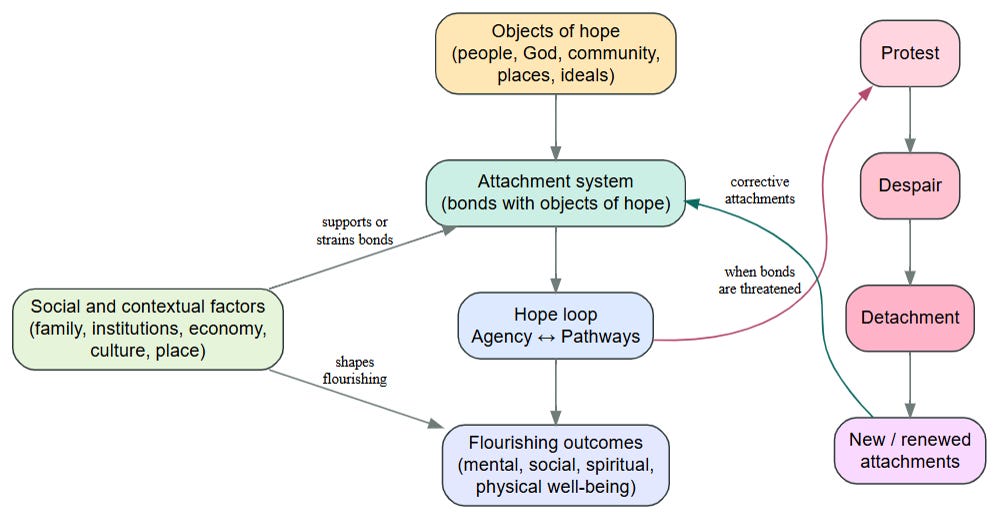
This is the insight behind my proposed Relational Theory of Hope, a new framework I am working on in a book that redefines hope as a relational process that links security and future orientation rather than as mere optimism or goal-setting. In this view, hope is born out of our sustained connections. It thrives when we feel anchored in safe connections, and it falters when those attachments are threatened or lost.

Hope as a Relational Process
Traditional psychology has treated hope as a cognitive skill. C. R. Snyder’s influential model, for instance, describes hope as the combination of agency (“the will to move”) and pathways (“the ways to move”). While that framework has helped researchers understand, at the basic motivational level, how hopeful people pursue goals, it leaves open an important question: Where does the will itself come from?
The relational theory answers that question by turning to attachment science. John Bowlby’s insights on attachment processes requires our focus. I am proposing that the same behavioral system that governs how we bond with caregivers or loved ones also underlies how we are tethered to our imagined futures. Every person invests their sense of safety in what can be called objects of hope—people, ideals, beliefs, or places that give life coherence. These objects function similar to objects of attachment, providing the emotional stability or secure bases from which we dare to imagine a tomorrow worth moving toward.
When attachment to these objects feels secure, hope flows naturally. We can endure hardship because we trust that our connections—to God, to others, to meaningful places—will hold. When those attachments are shaken, however, hope becomes fragile. We experience what I call the unmooring effect: a reparative process of protest, despair, and detachment that mirrors how people respond to relational loss.
The Mechanics of Hope
Within this relational framework, hope then operates as a regulatory loop. It balances two movements mentioned in Snyder’s hope theory:
Agency: the internal energy to act, sustained by physiological vitality and psychological security.
Pathways: the external routes or strategies that connect one’s agency to desired outcomes.
Agency and pathways are not self-contained; they depend on attachment networks. A person’s ability to act confidently depends on the felt security of their bonds, and their ability to find pathways depends on the relational and symbolic resources provided by those bonds (e.g., family, faith, identity, meaning, community, place-making).
When hope is threatened, these mechanisms destabilize. A bereaved person, for example, may lose both the energy to act (agency) and the imagination to see how life could be good again (pathways). Hopeful healing begins when new or renewed corrective attachments re-establish security at the detachment phase. A supportive community, a spiritual awakening, or reconnection with meaningful places can all reactivate the loop of agency and pathways, and thus may restore the relational movement of hope.
Disruption and Renewal of Hope
The proposed relational theory describes hope’s disruption as a three-phase process:
Protest: the first response to threatened connection with objects of hope, marked by striving to restore what was lost.
Despair: the recognition that restoration may be impossible, which may bring a collapse of motivation and meaning. This is perhaps where despair and hopefulness sets in.
Detachment: a turning away, which can lead either to withdrawal or to the formation of new (corrective) attachments.
These phases echo emphases from both attachment literature and trauma research. This relational theory of hope does not treat detachment, for example, as the end of hope but as a potential pivot. If new connections form—to fresh goals, communities, or transcendent realities—hope reorganizes itself around them. This makes hope not static optimism but a living and adaptive process that continually re-roots itself in new grounds of security.
The Social Nature of Hope
Because hope depends on enduring connections, it is inherently relational. Our recent studies from the Global Flourishing Study already show that adults report higher hope when they had warm relationships with parents, felt included, enjoyed good health in childhood, and participated in regular religious or community gatherings in the early years of life. Hope weakens when childhood involved abuse, strained family bonds, or experiences of exclusion. Social and demographic factors in adulthood, such as regular religious participation, work stability, and gender patterns in some contexts, also shape how strongly people hold hopeful expectations about life. The relational theory of hope explains why: when our networks are secure, our capacity to imagine the future expands. We borrow stability from those who are relationally connected to us, internalizing their confidence as our own.
This perspective helps clarify why isolation breeds despair. When individuals lose meaningful bonds - whether through conflict, displacement, or cultural breakdown - hope erodes. And this is not because they lack goals but because they lack a felt base of security from which or whom to pursue them. On the other hand, societies that foster these relational ties (e.g., strong community, family, and spiritual ties) cultivate resilience and flourishing because they sustain hope at a collective level.
Hope and Faith in Context
The relational theory also bridges psychology and faith. In religious traditions, hope has always been tethered to trust in something beyond oneself such as God’s faithfulness, divine providence, higher power or reality, or the sacred order of creation. The relational theory of hope provides a psychological grammar for this: faith functions as a secure attachment to the ultimate object of hope. When believers feel securely bonded to God, they experience hope as steady and self-renewing. When that bond feels broken, spiritual despair is likely to set in.
Place, too, plays a vital role here. People often form meaningful connections to environments that symbolize belonging, whether the home, a neighborhood, or a sacred site. Environmental psychology shows that these ties, studied scientifically as ‘place attachment’, contribute to well-being by fostering identity and continuity. The relational framing extends this insight because when people maintain what I have referred to in my work spiritual ties to place, they anchor hope spatially. They can hold onto meaning even when the future is uncertain because their surroundings remind them of who they are and where they belong.
Hope as a Bridge to Flourishing
If hope is relational, its influence extends across every domain of human flourishing. Research already links hope to better mental health, lower depression, higher life satisfaction, and improved physical outcomes. This is also consistent with our outcome-wide longitudinal analysis of hope and subsequent flourishing outcomes from the Global Flourishing Study. The relational theory can explain these associations as by-products of secure connections with objects of hope. When security is maintained, the nervous system regulates more effectively, social bonds deepen, and cognitive flexibility increases; these are all ingredients for flourishing.
In this sense, hope is not a single virtue among others but a psycho-spiritual meta-virtue: it regulates the system that supports all others. Faith, love, perseverance, gratitude, and compassion each depend on hope’s steady orientation toward a trustworthy future. Without hope, virtues decay into mere ideals; with it, they animate the whole of human life.
Why This Matters Now
I just got back from a hope working group meeting at Duke University organized by a colleague. We live in a time of great disconnection, as seen in things like social fragmentation, political polarization, and environmental loss. The relational theory of hope offers a different starting point for keeping the future alive. It tells us that the crisis of despair so many feel at the moment is not only emotional, but tethered to our relational connections. We are losing the bonds that hold hope together. Rebuilding hope, then, requires more than self-help; it requires re-connection to each other, to meaningful places, to the sacred stories that remind us that tomorrow is possible.
Hope is not the denial of suffering or eminent threat. It is the courage to stay connected through it. As long as our attachments hold, hope holds and with hope, the possibility of flourishing remains alive.