

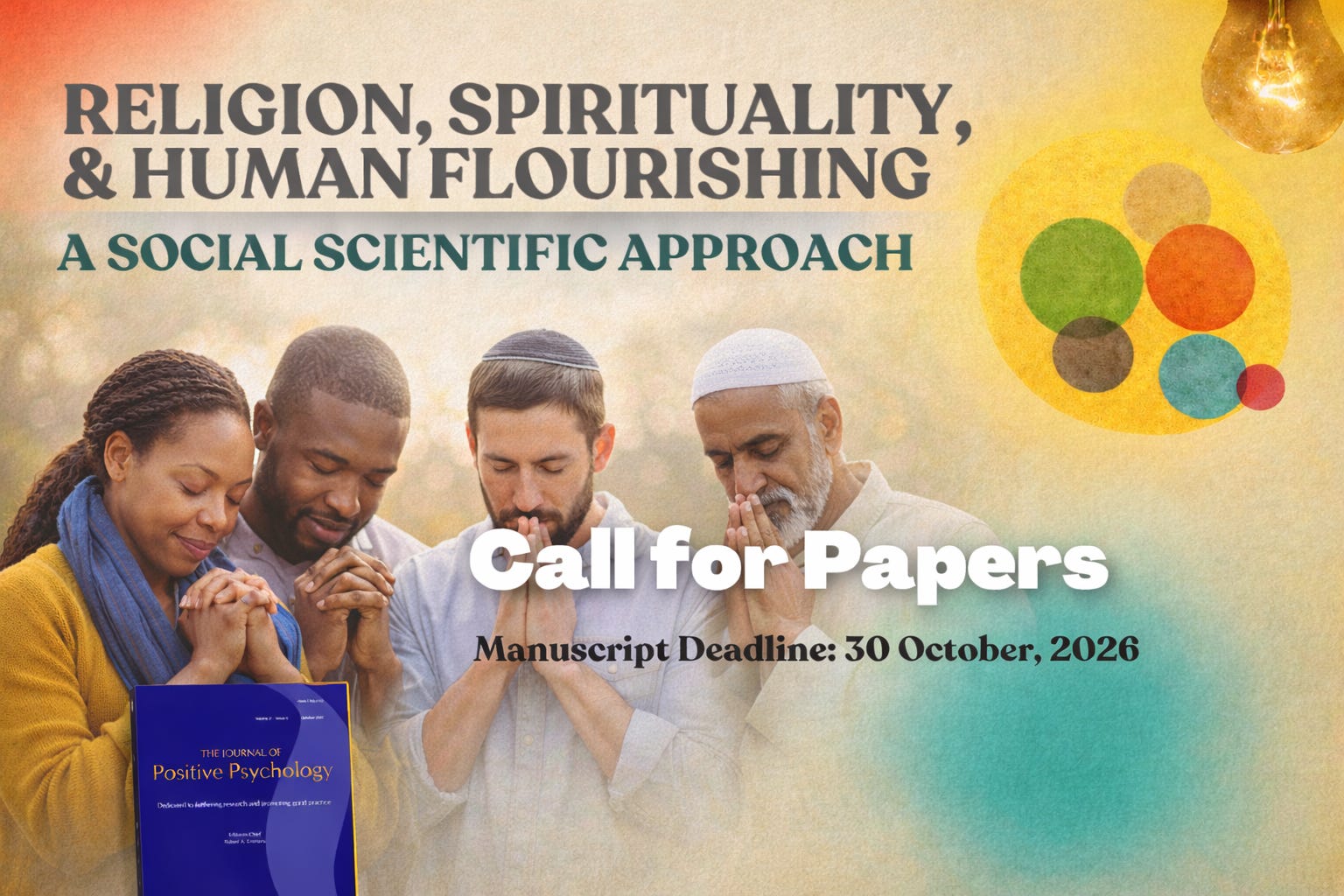
Call for Papers: Religion, Spirituality, and Human Flourishing
A Social Scientific Approach | The Journal of Positive Psychology
Religion and spirituality (R/S) have been integral to human life for millennia, shaping cultures, communities, and individual identities. In recent decades, there has been a growing interest in understanding how religion and spirituality contribute to human flourishing, particularly within the field of positive psychology (Counted, 2025). Human flourishing, defined as a state of optimal functioning in which all aspects of one’s life are good (VanderWeele et al., 2023; VanderWeele, 2017), is increasingly recognized as a multidimensional and nested construct that includes several dimensions: happiness and life satisfaction, mental and physical health, meaning and purpose, character and virtue, and close social relationships. However, flourishing extends beyond the individual to include the contexts or places in which people live, emphasizing how individual well-being is tethered to the environments that support it (Counted et al., 2023). Flourishing, therefore, is not just about the individual but also about the broader context in which they thrive (VanderWeele et al., 2023). This spatial orientation of a flourishing life is consistent with the idea that flourishing occurs when all aspects of a person’s life are good, including but not limited to their R/S environments (Counted et al., 2023; Meagher et al., 2025). R/S, with emphasis on the four B’s (belonging, believing, behaving, bonding; see Saroglou et al., 2020) and their normative functions (e.g., meaning-making, community, transcendence, etc), offer unique pathways to flourishing that warrant better investigation (VanderWeele, 2017). Religious traditions often provide theological frameworks for understanding what individuals and communities value most (VanderWeele, 2024) and for navigating adversity (Counted et al., 2024a,b). Focusing on what religious people and faith communities value as an orientation and unfolding of their flourishing framework allows researchers to consider the different R/S significant psychological processes that support, sustain, and strengthen human flourishing. This perspective is consistent with the capability framework, which demonstrates that flourishing is achieved when people are able to lead the kinds of lives they value (Counted et al., 2024), including tradition-specific well-being orientations shaped by religious and spiritual beliefs (VanderWeele et al., 2021).
While there is already a substantial body of research on R/S and well-being, this special issue seeks to highlight new scientific directions and progress in the field, particularly through the lens of human flourishing as a multidimensional and context-sensitive state of well-being in which R/S oriented individuals and faith communities live in alignment with what they most value. Previous special issues of The Journal of Positive Psychology have explored topics such as Gratitude to God (Volume 19, Issue 1, 2024 pages 1-190), Christian Positive Psychology (Volume 12, Issue 5, 2017 pages 425-508), Strengths and Virtues (Volume 14, Issue 1, 2019 pages 1-125), and Positive Psychology in Search of Meaning (Volume 8, Issue 6, 2013 pages 457-567), which while overlapping, do not fully capture the unique global and context-sensitive contributions of this issue. Even R/S, understood as psychosocial, psychospatial, physiological, and psychospiritual processes, are subject to psychological disruption or disturbances. People’s faith, sense of belonging to a faith comminity, or connection to the sacred or R/S places may be shaken by loss, conflict, or change.
Yet, such ruptures can also evoke adaptive responses—hope, forgiveness, meaning-making, etc.—that transform and strengthen R/S experiences. This dynamic reflects the broader four-stage framework of flourishing: mechanisms that sustain well-being, disruptors that threaten it, adaptive responses that restore it, and outcomes that express it. When R/S systems engage these positive adaptive pathways, they not only recover from disruption but often emerge with renewed strength and transcendence. Research has consistently demonstrated that religious and spiritual practices are associated with several well-being outcomes (Pawlikowski et al., 2019; Yaden et al., 2022). For example, studies have shown that religious involvement is linked to lower rates of depression, anxiety, substance abuse, and positively associated with several indicators of human flourishing (Koenig et al., 2012; Pawlikowski et al., 2019; VanderWeele et al., 2025). Religious practices such as prayer, meditation, and worship have been found to promote emotional regulation, reduce stress, and enhance life satisfaction (Pargament, 1997). However, negative adaptive R/S pathways can equally magnify maladaptive behaviors and negative experiences (e.g., suffering, radicalization, etc.). R/S practices can sometimes lead to exclusion, conflict, or rigid dogmatism, which may undermine well-being and social cohesion (Stark & Bainbridge, 1985). Individuals may also experience religious/spiritual struggles, such as feelings of abandonment by God, moral guilt, or conflicts with religious communities, which can increase psychological distress (Exline, 2013; Exline et al., 2014). Individuals who experience spiritual struggles or feel alienated from religious communities may tend to face increased psychological distress (Exline et al., 2014).
Unlike prior work, this special issue will focus on the mechanisms, disruptions, adaptive responses, and cross-national variations underlying the flourishing-religion relationship in contexts of global flourishing trends in R/S and negative aspects of religious involvement. This special issue will also seek to understand global human flourishing through the lenses of major world religions, which can both contribute to and complicate our understanding of human flourishing. Cultural and religious diversity necessitates a cross-cultural perspective, as the ways in which religion contributes to flourishing may vary substantially across different traditions and contexts (Cohen et al., 2005; VanderWeele et al., 2025). These complexities suggest that the relationship between R/S and flourishing is not universally positive and requires a nuanced understanding of how these forces operate in different religious contexts and across national lines. Drawing on existing global datasets (e.g., the Global Flourishing Study) may help to balance the potential benefit with these challenges for a comprehensive assessment of constructs of R/S and human flourishing, and how they intersect.
Positive psychology, with its focus on strengths, virtues, and the positive adaptive factors that enable individuals and communities to thrive, provides an ideal framework for scrutinizing R/S complexities. The proposed special issue will not only advance our understanding of how R/S can promote human flourishing but also critically examine global challenges and limitations of their role in sustaining well-being. This special issue will highlight not only the processes and new directions of research on R/S and well-being but also what the science of human flourishing can offer in advancing this scientific field. While existing research has extensively documented the associations between religious practices and well-being outcomes, human flourishing provides a unique language and framework to examine well-being multidimensionally and contextually within the lives of religious people and their communities and traditions.
The proposed special issue will address gaps in the literature by:
Highlighting cross-cultural and interfaith perspectives on R/S and flourishing to capture how different traditions and contexts shape well-being and virtue development across the globe.
Exploring the mechanisms and processes—psychosocial, psychospiritual, psychospatial, and physiological—through which R/S promote human flourishing.
Investigating adaptive responses to disruption in R/S life, including how psychospiritual processes facilitate resilience, recovery, and post-traumatic growth.
Examining the potential challenges and negative adaptive pathways of religious involvement, such as religious struggles, alienation, exclusion, radicalization, or rigid dogmatism, and their implications for human flourishing or languishing.
Integrating global datasets and innovative methods (e.g., the Global Flourishing Study) to address cross-national variations and test models that link R/S engagement with flourishing outcomes.
Advancing theory and measurement by refining conceptual models that position R/S as dynamic systems capable of both sustaining and disrupting flourishing, while also encouraging open science practices and methodological transparency.
Special Issue Editor
Victor Counted, PhD, is uniquely positioned to serve as the guest editor for this special issue on religion, spirituality, and human flourishing, given his expertise as a psychological scientist and his extensive contributions to the fields of well-being science and the psychology of religion. Counted is Associate Professor of Psychology and Director of the Office of Research and Sponsored Programs at Regent University, where he also leads the Christian Flourishing Science lab. He is a faculty affiliate of the Human Flourishing Program at Harvard University and an executive board member of the International Association for the Psychology of Religion. Counted has PhDs in Health Psychology from Western Sydney University and the Psychology of Religion from the University of Groningen. He is also an Associate Editor of the Journal of Positive Psychology and Editor of Springer’s Religion, Spirituality, and Health: A Social Scientific Approach book series. His interdisciplinary research examines the psychological processes—mechanisms, disruptors, adaptive responses, outcomes—that shape human flourishing across cultures. His work explores how these dimensions interact to support, sustain, and strengthen flourishing and how disruptions to these processes can lead to challenges that require adaptive responses. He integrates psychological science and practice with cross-cultural healthcare approaches to develop evidence-based and theoretically-driven research interventions that promote health and well-being for individuals and communities.
Submission Instructions
I invite scientifically oriented manuscripts, e.g., empirical, methodological, systematic reviews, meta-analysis, and meta-theoretical contributions that advance the scientific study of religion and spirituality within the framework of human flourishing. Submissions should demonstrate conceptual clarity, methodological rigor, and global relevance, and ideally meet two or more of The Journal of Positive Psychology’s eight evaluative criteria: (1) reporting more than a single study and demonstrating replication of findings; (2) use of multiple measures beyond self-report; (3) application of sophisticated or ambitious methodologies; (4) grounding in strong theoretical frameworks; (5) presentation of creative or original ideas and methods; (6) potential to substantially influence research in positive psychology; (7) clear, precise, and well-written presentation; and (8) adherence to open science practices. This special issue welcomes different perspectives and inter-disciplinary contributions that expand how R/S, in their varied expressions and contexts, shape the flourishing of individuals and communities around the world.
Read CfP on the journal homepage.
Proposed Timeline:
- Submission Deadline: October 2026
- Peer Review Completion: December 2026
- Revisions and Final Decisions: June 2027
- Publication: August 2027
- Publication of Individual Papers Online: As they become available (starting June 2027)
- Issue Publication: Beginning of 2028
References
Cohen, A. B., Hall, D. E., Koenig, H. G., & Meador, K. G. (2005). Social versus individual motivation: Implications for normative definitions of religious orientation. Personality and Social Psychology Review, 9(1), 48–61.
Counted, V. (2025). An Introduction to the Science of Christian Flourishing: A Domain-Based Approach. Journal of Psychology and Christianity 44(1), 4-14
Counted, V., Allen, K., Johnson, B. R., & VanderWeele, T. J. (2024d). The roots of belonging: Childhood predictors of belonging in 22 countries. Preprint submission at https://osf.io/ykrcf
Counted, V., Cowden, R. G., & Lomas, T. (2024). Global diversity in spatial (rural-urban) well-being in over 100 countries. Cities, 149, 104987.
Counted, V., Johnson, B. R., Allen, K., Miner, M., & VanderWeele, T. J. (2024c). Demographic variation in belonging across 22 countries: Findings from the Global Flourishing Study. Submission proposal at https://osf.io/4bdp7
Counted, V., Long, K. N. G., Cowden, R. G., Witvliet, C., Cortright, A., Gibson, C. B., Walsh, J., Purcell, E., Hathaway, W., Garzon, F., Johnson, B. R., & VanderWeele, T. J. (2024a). Seeds of hope: A cross-national analysis of childhood predictors of hope in 22 countries. Preprint submission at https://osf.io/74w3b
Counted, V., Long, K. N. G., Cowden, R. G., Witvliet, C., Cortright, A., Gibson, C. B., Walsh, J., Purcell, E., Hathaway, W., Garzon, F., Johnson, B. R., and VanderWeele, T. J. (2024b). Where hope thrives: Demographic variation in hope across 22 countries. Preprint submission at https://osf.io/89c3t
Counted, V., Ramkissoon, H., Captari, L. E., & Cowden, R. G. (Eds.). (2023). Place, spirituality, and well-being: A global and multidisciplinary approach (Vol. 7). Springer Nature.
Exline, J. J. (2013). Religious and spiritual struggles. In K. I. Pargament, J. J. Exline, & J. W. Jones (Eds.), APA handbook of psychology, religion, and spirituality (Vol. 1, pp. 459–475). American Psychological Association.
Kim, E. S., Bradshaw, M., Padgett, R. N., Chen, Y., Shiba, K., Ritchie-Dunham, J. L., Case, B. W., Johnson, B. R., & VanderWeele, T. J. (2024b). Tracing the childhood roots of adult purpose and meaning: A cross-national analysis of 22 countries in the Global Flourishing Study. Preprint submission at https://osf.io/yrn8h
Kim, E. S., Padgett, R. N., Bradshaw, M., Shiba, K., Chen, Y., Ritchie-Dunham, J. L., Case, B. W., Johnson, B. R., & VanderWeele, T. J. (2024a). Mapping demographic variations in purpose and meaning across the world: A cross-national analysis of 22 countries in the Global Flourishing Study. Preprint submission at https://osf.io/nj9h2
Koenig, H. G. (2012). Religion, spirituality, and health: The research and clinical implications. International Scholarly Research Notices, 2012(1), 278730.
Koenig, H. G., King, D. E., & Carson, V. B. (2012). Handbook of religion and health (2nd ed.). Oxford University Press.
Lim, C., & Putnam, R. D. (2010). Religion, social networks, and life satisfaction. American Sociological Review, 75(6), 914–933. https://doi.org/10.1177/0003122410386686
Meagher, B. R., Cowden, R. G., Goldammer, L., Piazza, M., Aten, J., & Counted, V. (2025). The Varieties of Spiritual Ties to Place: A Latent Class Analysis. Psychology of Religion and Spirituality. Advance online publication. https://doi.org/10.1037/rel0000560
Pargament, K. I. (1997). The psychology of religion and coping: Theory, research, practice. Guilford Press.
Pargament, K. I. (2001). The psychology of religion and coping: Theory, research, practice. Guilford press.
Pawlikowski, J., Białowolski, P., Węziak-Białowolska, D., & VanderWeele, T. J. (2019). Religious service attendance, health behaviors and well-being—an outcome-wide longitudinal analysis. European journal of public health, 29(6), 1177-1183.
VanderWeele, T. J., Johnson, B. R., Bialowolski, P. T., Bonhag, R., Bradshaw, M., Breedlove, T., Case, B., Chen, Y., Chen, Z. J., Counted, V., Cowden, R. G., de la Rosa, P. A., Felton, C., Fogleman, A., Gibson, C., Grigoropoulou, N., Gundersen, C., Jang, S. J., Johnson, K. A., Kent, B. V., Kim, E. S., Kim, Y. I., Koga, H. K., Lee, M. T., Le Pertel, N., Lomas, T., Long, K. N. G., Macchia, L., Makridis, C. A., Markham, L., Nakamura, J. S., Norman-Krause, N., Okafor, C. N., Okuzono, S. S., Ouyang, S., Padgett, R. N., Paltzer, J., Ritchie-Dunham, J. L., Ritter, Z., Shiba, K., Srinivasan, R., Ssozi, J., Weziak-Bialowolska, D., Wilkinson, R., Woodberry, R. D., Wortham, J., & Yancey, G. (2025). The Global Flourishing Study: Study profile and initial results on flourishing. Nature Mental Health. https://doi.org/10.1038/s44220-025-00423-5
VanderWeele, T. J. (2017). Religious communities and human flourishing. Current Directions in Psychological Science, 26(5), 476–481. https://doi.org/10.1177/0963721417721526
VanderWeele, T. J. (2024). A Theology of Health: Wholeness and Human Flourishing. University of Notre Dame Press.
VanderWeele, T. J., Long, K., & Balboni, M. J. (2021). In: Lee, M.T., Kubzansky, L.D., & VanderWeele, T.J. (eds), Tradition-specific measures of spiritual well-being. Measuring well-being: Interdisciplinary perspectives from the social sciences and the humanities, 482-498. Oxford University Press
VanderWeele, Tyler J., Brendan W. Case, Ying Chen, Richard G. Cowden, Byron Johnson, Matthew T. Lee, Tim Lomas, and Katelyn G. Long (2023). Flourishing in critical dialogue. SSM-Mental Health, 3, 100172.
Saroglou, V., Clobert, M., Cohen, A. B., Johnson, K. A., Ladd, K. L., Van Pachterbeke, M., Adamovova, L., Blogowska, J., Brandt, P.Y., Çukur, C.S., & Tapia Valladares, J. (2020). Believing, bonding, behaving, and belonging: The cognitive, emotional, moral, and social dimensions of religiousness across cultures. Journal of Cross-Cultural Psychology, 51(7-8), 551-575.
Yaden, D. B., Batz-Barbarich, C. L., Ng, V., Vaziri, H., Gladstone, J. N., Pawelski, J. O., & Tay, L. (2022). A meta-analysis of religion/spirituality and life satisfaction. Journal of Happiness Studies, 23(8), 4147-4163.