

Did Pope Leo XIV Just Dismantle the Palantir Logic in His Long-Awaited Magnifica Humanitas?
In one of the most widely read sections of the document, Pope Leo XIV effectively deconstructs the business model of companies like Palantir.

On May 15, 2026, the Vatican released what many believe to be the most consequential document of the 21st century: Magnifica Humanitas. While the global press initially focused on the Pope’s general acceptance of AI as a “valuable tool,” a closer reading reveals a targeted, surgical dismantling of the “predictive logic” that defines the modern data-industrial complex—specifically the models utilized by transnational surveillance and analytics giants like Palantir.
In Magnifica Humanitas, Pope Leo XIV does not merely offer an ethical “guidebook”; he identifies a new, predatory form of power that threatens the very core of human agency.
The Shift of Sovereignty
The Pope begins by noting that the “drivers of development” have shifted from the public interest to “private, often transnational, parties that are endowed with resources and the capacity to intervene that surpass those of many Governments” (Para 5). He is not just making a comment on corporate wealth; it is a warning about the privatization of sovereignty. Pope Leo observes that this “technological power thus takes on an unprecedented, predominantly ‘private’ aspect, which makes it even more challenging to discern, govern and direct such power toward the common good” (Para 5).

For companies whose business models rely on providing governments with the “invisible infrastructure” (Para 107) to manage populations, the Pope’s critique is devastating. He argues that when we entrust an algorithm with the power to “select who is worthy or not, without anyone bearing responsibility for that judgment,” we are handing over “the task of redefining the boundaries of human possibilities” (Para 103).
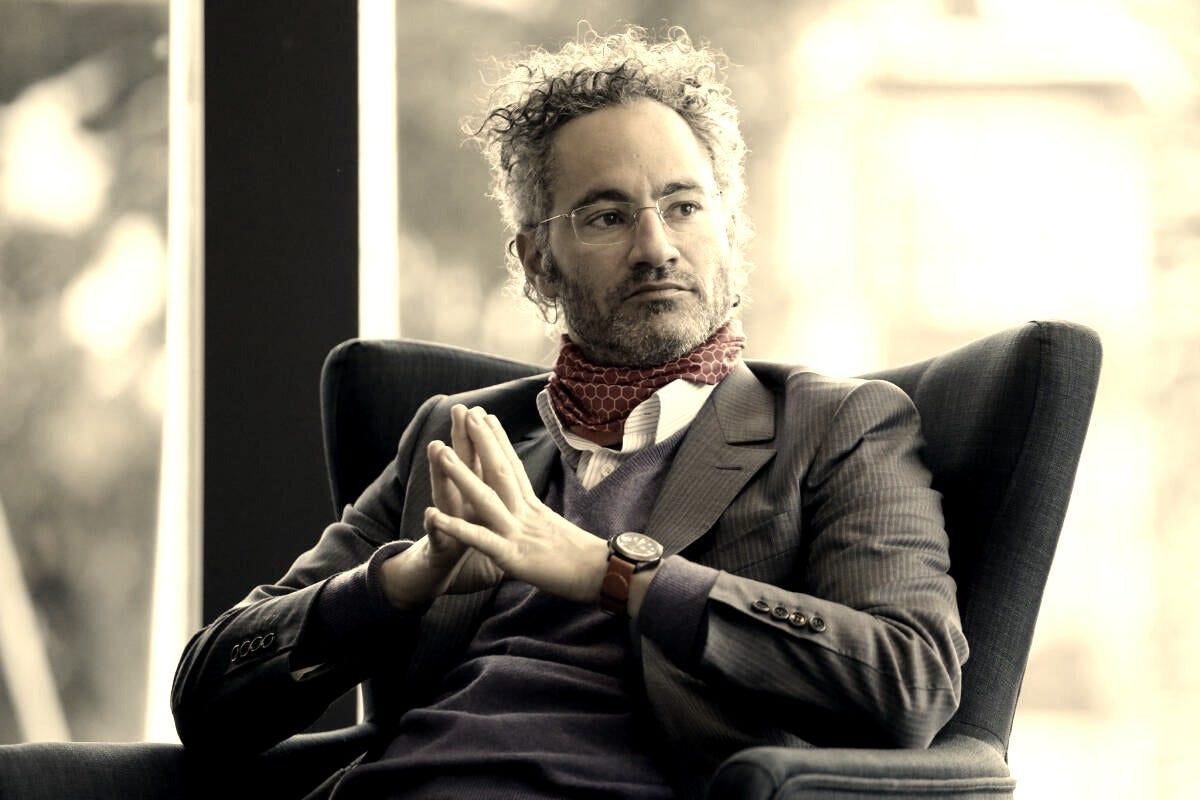
Although Palantir was not mentioned in the document, any one with knowledge of the current events in modern history, knows that Palantir is the quintessential embodiment of the “private, often transnational” parties (Para 5) and the “invisible infrastructure” (Para 107) that Pope Leo XIV identifies as the architect of a “new mindset of extraction” (Para 178), effectively turning human life into the “rare earths” of a predictive economy that threatens our very sovereignty.
The Architecture of Visibility
At the heart of the “Palantir logic” is the ability to profile, predict, and influence behavior. Pope Leo XIV describes this as a “further risk, less visible but no less serious,” facilitated by the “massive collection of data and use of algorithmic systems” (Para 171).
He writes:
“When every action—movements, purchases, relationships and preferences—leaves a trace, a new form of power emerges, namely the power to profile, predict and influence behavior, often without individuals being fully aware of it” (Para 171).

The Encyclical warns that this creates an “architecture of visibility,” where what is amplified or rendered invisible “ultimately shapes opinions and choices, fostering conformity and self-censorship” (Para 171). For a magazine publication dedicated to human flourishing, this is the ultimate alarm: a society that is constantly being “predicted” is a society that has lost its capacity for the “slow and arduous effort” of genuine freedom (Para 62).
Data as the New Colonialism
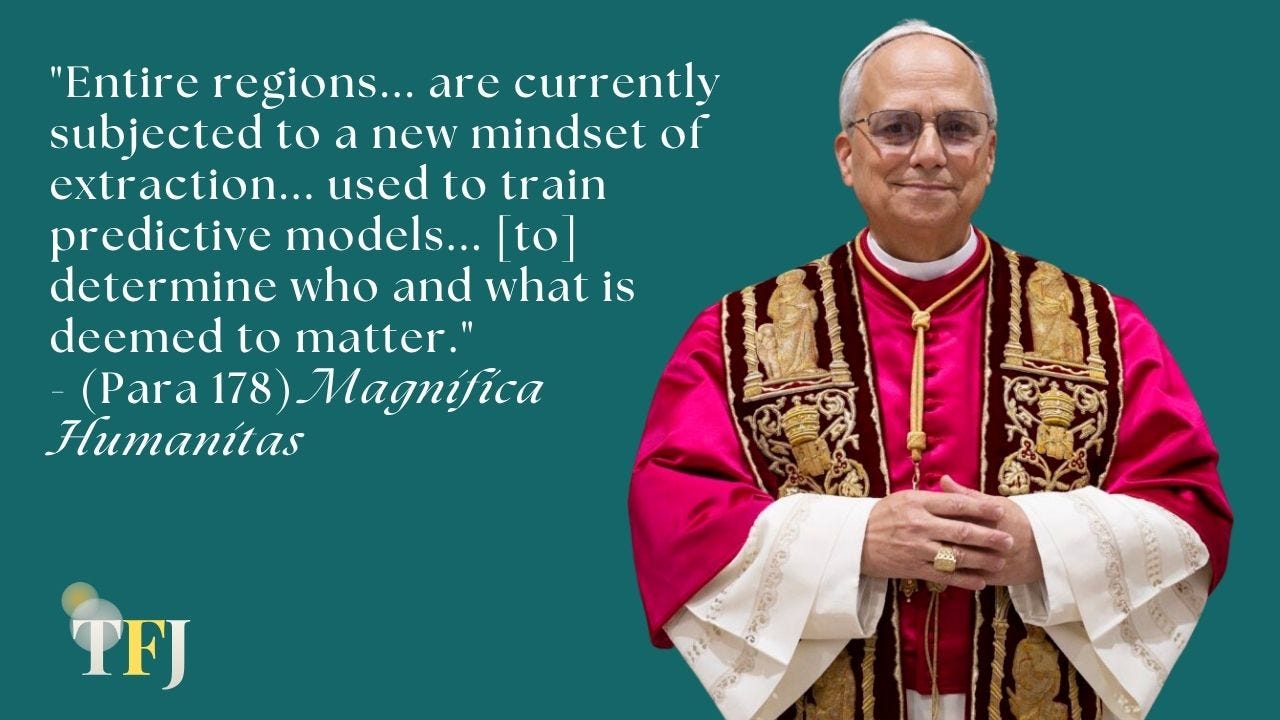
Perhaps the most blistering section of the document—and the one that most directly challenges the global data-harvesting trade—is the Pope’s identification of a “new mindset of extraction” (Para 178). He argues that “colonialism assumes new forms” today, no longer dominating only bodies, but appropriating data.
The Pope identifies the specific assets that companies like Palantir thrive on—health data, epidemiological profiles, and genetic maps—as the “new ‘rare earths’ of power” (Para 178). He notes that this data is “once aggregated and analyzed... used to train predictive models... [to] determine who and what is deemed to matter” (Para 178). He continues:
“Those who control the health data of entire peoples... possess a structural leverage over the future, for they can shape needs and markets” (Para 178).
In the eyes of Leo XIV, this is a violation of the “universal destination of goods” (Para 65). He argues that “ownership of data cannot be left solely in private hands” (Para 108) and that the current distribution of power allows “a handful of actors to dictate these processes on their own” (Para 72).
The Call to Flourish
The Pope’s conclusion is quiet clear:
we must “disarm” these systems. This does not mean a rejection of technology, but a rejection of the “technocratic paradigm” (Para 92) that views humans as “data, a cog in a machine or a commodity” (Para 180).
If we are to flourish, we must follow the “Way of Nehemiah,” a model introduced in the document as a way of “shared responsibility” (Para 8) that rebuilds relationships “piece by piece” (Para 184) rather than the “Babel Syndrome” of “automated control” (Para 132). Magnifica Humanitas is more than a letter for our time. One could say that it is a prophetic declaration of independence from the algorithmic gods of the 21st century.