

Pepe Leo Calls for AI to be Disarmed
In Magnifica Humanitas, Pope Leo XIV does something no major world leader has done. He names the AI race itself, not just its outputs, as a form of armed conflict already producing casualties.
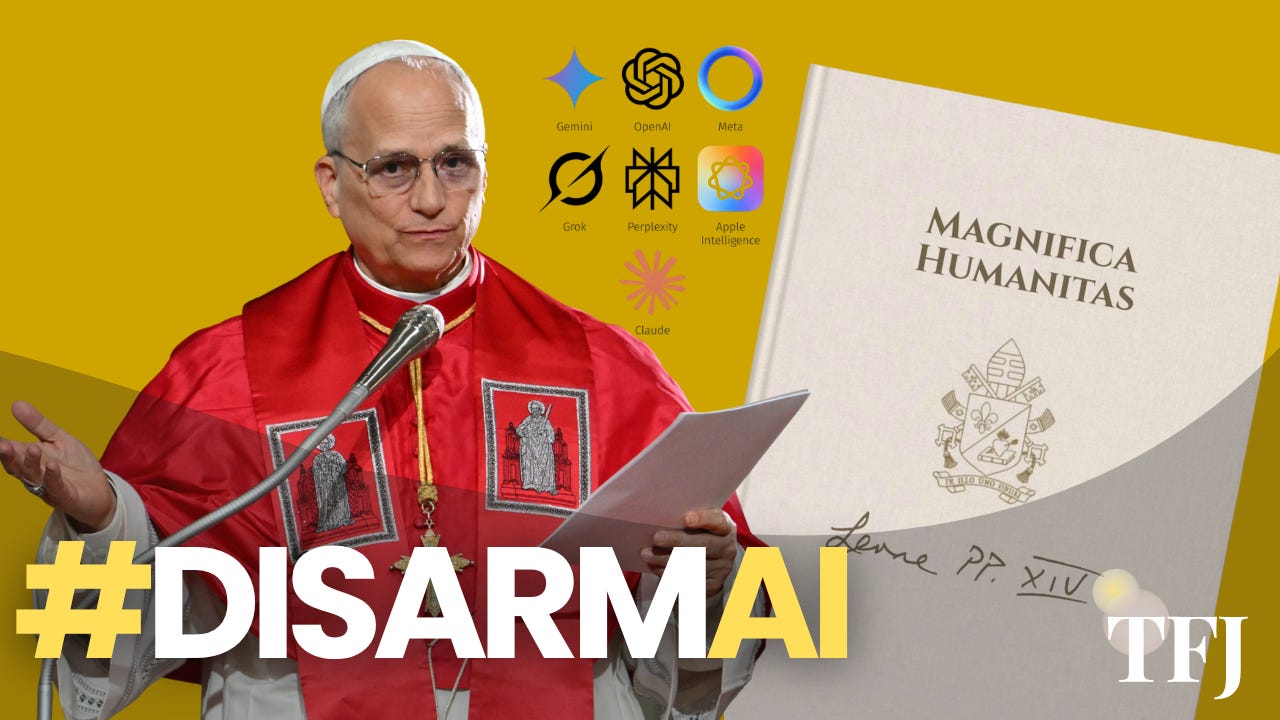
On May 25, 2026, a pope and the co-founder of one of the world’s leading artificial intelligence laboratories shared a stage at the Vatican to release a document about what AI is doing to the human person. The image is worth pausing over. Christopher Olah of Anthropic, alongside two cardinals and two theologians, presented an encyclical written by a pope who, ten days earlier, had signed the document on the 135th anniversary of Rerum Novarum, the 1891 letter that defended factory workers against the machinery of the first industrial revolution. The symmetry was deliberate. Two industrial revolutions. Two Leos. The same question: who is being ground up inside the new machine, and who will name them on the world stage?
Most of the press coverage will focus on the optics. A pope sharing a stage with an AI executive is a story by itself. But the optics are not the news. The news is buried in paragraph 110 of the encyclical, and it is the most radical thing a major world leader has said about artificial intelligence in this decade.
Pope Leo XIV calls for the world to disarm AI.
What “disarm AI” actually means
The phrase appears in a paragraph that almost no news outlet will quote in full, because it does something the standard policy vocabulary has no category for. Leo XIV writes that the AI industry is operating inside a mentality of “armed” competition. He clarifies immediately that he does not mean military competition alone. He means economic and cognitive competition. He means the race for ever more powerful algorithms, larger datasets, and geopolitical or commercial dominance. He means the assumption that whoever builds the most capable system fastest will get to set the terms for everyone else.
To disarm AI, in Leo XIV’s framing, is to discredit that assumption itself. It is to refuse the premise that technical power confers the right to govern. It is to break the logic of the race.
Most warnings about AI focus on what the machines might do to us. Leo XIV’s warning is different. It focuses on what the race to build the machines is already doing to us, and to the people who can least afford to be in its way.
This is an important move than the AI safety community has been willing to make. Geoffrey Hinton, Yoshua Bengio, and the long line of researchers who have warned about catastrophic risk have framed the problem primarily as a technical alignment question or a future-tense scenario in which sufficiently powerful systems escape human control. Their warnings are serious and deserve a hearing. But they leave the structure of the race itself intact. They ask whether the cars in the race can be made safer. Leo XIV asks why we are racing at all, and who is being run over while we do.
The casualties are already counted
This is the harder move, and the encyclical takes it seriously. In §173, Leo XIV gives a description of the present that any reader paying attention to the AI industry knows is accurate, even if it is rarely said this plainly from a public pulpit. He names the people whose bodies are already part of the supply chain.
Casualty One
The hidden workers
Millions of people, predominantly young women, doing data labeling, model training, and content moderation on disturbing material for minimal wages. The encyclical names them by their function and by their absence from the public conversation about who builds AI.
Casualty Two
The children in the mines
Children and adolescents in some regions of the world working in dangerous conditions to extract the rare earth elements that go into the microprocessors AI systems require. Their bodies, in Leo XIV’s words, are scarred and worn down so that computational flow may continue uninterrupted.
Casualty Three
The data-colonized
Entire populations in the Global South whose health data, genetic maps, and demographic information are extracted, often under the framing of aid or research, then aggregated to train models that will be sold back to them. Leo XIV calls this a new colonialism.
Casualty Four
The deskilled and surveilled
Workers in wealthy economies forced to adapt to the pace of machines rather than the other way around, subjected to automated surveillance, and relegated to rigid, repetitive tasks. The encyclical quotes the Vatican’s earlier Antiqua et Nova note on this directly.
Casualty Five
The trafficked
Criminal networks using AI-enabled platforms, anonymous payments, and profiling to recruit, control, and move victims, very often minors, through the same digital circuits that carry the global economy. The encyclical places trafficking and AI in the same paragraph for a reason.
Casualty Six
The young and the lonely
Children exposed early and unsupervised to digital systems engineered to capture their attention, with documented effects on sleep, attention, emotional regulation, and the capacity for genuine relationship. The encyclical does not soften this finding.
These are not predictions. These are people who exist now. Leo XIV’s argument is that any framework which treats AI risk as a future-tense catastrophe to be averted while ignoring this present-tense list of casualties is participating in a moral evasion.
Why the language of war is not metaphor
The reflex response to the encyclical’s framing will be that “disarm AI” is rhetorical overreach, that the AI industry is not literally a war and that calling it one cheapens the word. This response is worth taking seriously, because the integrity of language matters, and inflated comparisons damage moral discourse. But Leo XIV anticipates the objection and answers it carefully.
His point is about the structure of the tool. A war is not defined by uniforms or borders. It is defined by a competitive logic in which actors believe their survival depends on out-producing or out-positioning an enemy, and in which that logic produces casualties as a normal byproduct of the competition. By that definition, the AI industry now operates in conditions remarkably close to a wartime economy. Firms openly speak of an existential race against each other and against geopolitical rivals. Investment is justified by the language of national security. Talent is treated as a strategic resource to be denied to competitors. Capabilities are kept opaque to prevent enemies from learning from them. And the casualties are externalized to populations that have no voice in the contest.
If that is not a war in the conventional sense, it is something close enough that the conventional categories no longer protect us from its consequences. Leo XIV’s contribution is to refuse the polite vocabulary that would let us pretend otherwise.
The Central Move
To disarm AI is not to reject technology. Leo XIV is explicit about this. It is to refuse the assumption that technical power confers the right to govern, and to open AI development to the same scrutiny, regulation, and shared accountability that humanity has slowly and painfully built around other powerful technologies.
What he is asking for is not a treaty. Pope Leo seeks a transformation in how the industry understands itself.
The third position
The public debate about AI tends to collapse into two camps. The optimists argue that the technology will be net positive and that excessive caution will only hand advantage to less scrupulous developers. The catastrophists argue that the technology may end the human story and that everything else is secondary to preventing that outcome. Both camps share an assumption: that the central question is what AI will do once built.
Leo XIV is articulating a third position, and it is the position the AI safety conversation has needed for some time. The central question, he argues, is not what AI will do. It is what the race to build AI is doing already, and what kind of human person is being shaped, sold, and discarded in the process of its construction.
This is why the encyclical does not read like a typical Vatican intervention in a technology debate. It does not call for prohibitions. It does not romanticize the pre-digital past. It accepts that AI will be part of human life going forward. What it refuses is the framing that the race itself is morally neutral, and that the casualties of the race are an acceptable cost of progress. On both points, the document is uncompromising.
The question is not whether AI will be good or bad. The question is what kind of human person we are willing to count as a cost while we find out.
What disarmament would look like
Leo XIV does not leave the phrase abstract. The encyclical names specific moves that would constitute disarmament in practice.
The first is transparency in supply chains. No competitive advantage should be built on hidden exploitation, and the labor and material chains that produce AI systems should be subject to the same scrutiny as any other industry. The second is independent oversight of algorithms that make consequential decisions about employment, credit, services, and reputation. The third is the treatment of data as a common good rather than as private property to be extracted from populations who have no leverage to refuse. The fourth, and the sharpest, is the absolute prohibition of autonomous weapons systems that delegate lethal decisions to machines. On this last point Leo XIV is direct:
no algorithm can make war morally acceptable.
The Vatican’s position, formally restated, is that AI-enabled warfare in which machines select and engage targets without effective human control cannot be morally licit, full stop.
These are not utopian demands. They are versions of the same accountability frameworks humanity has built, slowly and incompletely, around nuclear technology, pharmaceutical research, and medical experimentation. The argument is that AI now warrants the same seriousness, and that the industry’s resistance to providing it is itself one of the clearest signs that the disarmament is needed.
The flourishing question
There is a deeper reason this encyclical matters for anyone working on human flourishing, and it is not the one most readers will reach for. The standard frame would say that AI poses risks to wellbeing and that policy should mitigate those risks. That frame is true but shallow. Leo XIV is making a more demanding claim. He is saying that the question of whether human flourishing remains possible at all depends on whether we can build technologies without sacrificing the people who are not in the room when the technologies are designed.
The contemporary science of human flourishing has been mapping the conditions under which persons across cultures actually thrive. Meaning, relationships, character, health, material sufficiency, and the structures that hold these together. My own work on the Relational Theory of Hope sits inside that project, and what the data keep showing is that flourishing is irreducibly relational. It depends on bonds, on place, on being seen, on the moral imagination of communities that refuse to write any person out of the picture.
Leo XIV’s encyclical is the moral and theological articulation of what the empirical science is also slowly demonstrating. A civilization cannot flourish on infrastructure built from the discarded bodies and unrecognized labor of the people it has chosen not to count. The casualties of the AI race are not external to the question of whether AI will produce a flourishing future. They are the answer to the question.
The Closing Thought
The most provocative line in Magnifica Humanitas is not about machines. It is about us. Leo XIV writes that
the construction of Babel or the rebuilding of Jerusalem begins within each one of us.
The disarmament he calls for is not, in the end, a policy program. It is a conversion of the imagination that refuses to accept that the race we are running is the only race available.
Whether the AI industry can hear that is the question this encyclical leaves on the table.
one of my first articles here was about AI. The other day I wrote a piece on the death penalty. I first asked an AI if the state had authority to issue such a sentence. It said yes a state had authority. Then it read my article on the death penalty and sovereignty and said no the state does not. So AI can learn and be taught.
https://andrewhildebrandt.substack.com/p/ai-and-the-architecture-of-loyalty