

Our Summer Trips Are Not Mission Trips
My students asked me a question in class this week, and I hedged. Here is the answer I should have given.

We were working through the experimental psychology literature on parochial altruism — the well-replicated finding that humans, and especially people of faith, cooperate generously with their in-group while showing markedly less concern, and sometimes outright hostility, toward outsiders. The data are uncomfortable. They suggest that much of what we call moral behavior is calibrated to the boundary of the group rather than to the dignity of the person in front of us. We were sitting with that, as one does, when our class discussion slipped toward my concern about short-term mission trips. Some of my students pressed me to explain what I meant.
I hedged in the moment. I said something about how the picture is complicated, that intentions matter, that there is real good done. All of that is true. But I walked out of the classroom knowing I had not answered the question I was actually asked. So let me try again here, in print, because I think the honest answer is one that the American church needs to hear before another summer of departures begins.
The short answer is yes. The American short-term mission trip, as it is currently practiced, looks a great deal like parochial altruism wearing the borrowed clothing of universal Christian love. And the gap between what we say it is and what it actually does has grown wide enough that I no longer think we can keep using the word missions without flinching.
A practice that did not always exist
It helps to remember that this is a new thing. For most of Christian history, missions meant going and not coming back. Patrick stayed in Ireland. Boniface stayed among the Germanic peoples and died there. The Jesuits who reached Japan in the sixteenth century learned the language, wore the clothes, and were buried in the soil. William Carey, often called the father of modern Protestant missions, sailed for India in 1793 and never returned to England. Hudson Taylor spent fifty-one years in China. Adoniram Judson buried two wives and most of his children in Burma. Whatever else one thinks of the colonial entanglements of that era, the missionary vocation was a vocation. It cost a life.
The short-term mission trip as we know it did not exist before the Second World War. It is a product of three converging developments in the second half of the twentieth century: cheap commercial air travel, the rise of parachurch youth organizations like Operation Mobilization (founded in 1957) and Youth With A Mission (founded in 1960), and the emergence of American evangelicalism as an affluent suburban movement with disposable income, paid vacation, and a felt need to do something with both. Within a generation, the practice had become institutionalized in nearly every evangelical youth group and Christian college in the country. Current estimates put the number of Americans going on short-term mission trips at well over a million and a half each year, with annual spending in the billions of dollars. This is not a minor adjunct to the missionary enterprise. It has, in budget and in cultural weight, largely become the enterprise.
And it is almost entirely a North American phenomenon. Nigerian and Korean and Brazilian Christians are sending long-term missionaries in extraordinary numbers, often to harder places than American missionaries are willing to go. Americans, increasingly, send teenagers for ten days.
“The missionary vocation was a vocation. It cost a life.”
What the evidence actually shows
Researchers have been looking at this for two decades now, and the findings are remarkably consistent. Kurt Ver Beek’s study of post-Hurricane Mitch housing reconstruction in Honduras compared communities served by short-term American teams against communities where local labor was hired with the equivalent funds. He found no meaningful long-term difference in housing outcomes, spiritual outcomes, or community development. The American teams cost roughly thirty thousand dollars per house. Local labor would have built four houses for the same money, employed Hondurans, and left behind skills rather than memories.
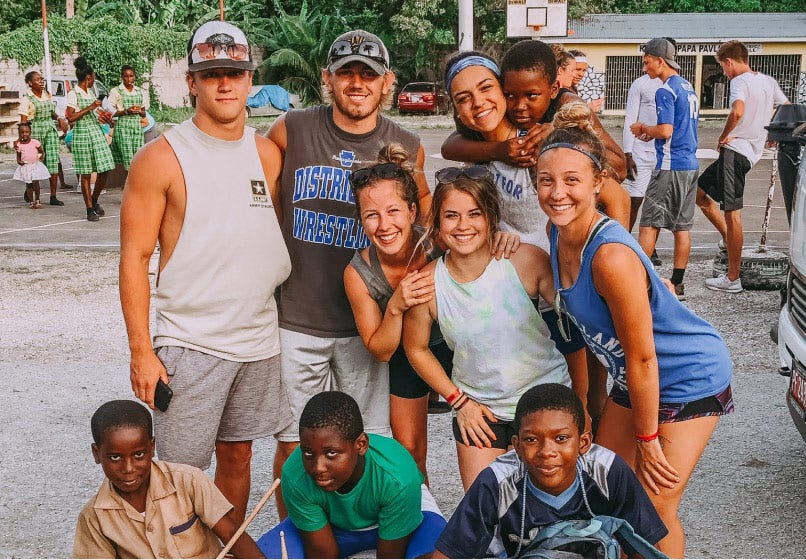
Robert Priest, who has done more ethnographic work on this than anyone, has concluded that the short-term mission trip functions primarily as a rite of passage for the American participant. It is formation for the sender, not evangelization of the receiver. Brian Howell, in his book on the subject, shows how participants come home rehearsing a narrative they were given before they ever left — the script of being changed, of seeing the real face of poverty, of returning grateful. The script is so consistent across trips, denominations, and destinations that it cannot plausibly be coming from the trips themselves. It is a cultural performance.
Steve Corbett and Brian Fikkert’s When Helping Hurts documented, painfully, the ways in which well-meaning short-term teams routinely undermine local economies, displace local leadership, create dependency, and damage the long-term work of indigenous churches and missionaries who must clean up afterward. The orphanage tourism industry in places like Cambodia and Haiti — which exists because of American demand for emotional encounters with children — has been linked to the active separation of children from living parents. This is not a fringe critique. It is now mainstream missiology.
Where the psychology gets uncomfortable
This is the point at which the parochial altruism literature stops feeling academic. The behavioral signature of parochial altruism is high-cost, high-visibility cooperation that strengthens the in-group bond while delivering modest or negligible benefit to the out-group it claims to serve. The short-term mission trip fits this signature almost perfectly.

Consider the structure. The cost is high and conspicuous, often paid through public fundraising in the home church, which produces social recognition before the trip has even begun. The duration is short, which limits real entanglement with the recipient community and protects the participant from the kind of disruption that long-term presence would produce. The destination is photogenic, which produces images that circulate back through the sending community as evidence of seriousness and faith. The recipients are usually members of a racial, economic, and cultural out-group, which makes the in-group’s generosity legible as generosity. And the return is celebrated with testimonies, slideshows, and renewed status within the home congregation.
Every one of these features serves the bond inside the group. Almost none of them serves the person who was visited. The mathematics of it should trouble anyone who reads the Sermon on the Mount carefully. Jesus reserved his sharpest warnings for exactly the kind of piety that is performed in a way that signals to the in-group. He did not warn against generosity. He warned against generosity that is visible.
The structural mismatch
When a practice consistently produces benefits for the senders that vastly exceed the benefits to the receivers, and when the language used to describe the practice systematically conceals this asymmetry, something has gone wrong at the level of the institution, not the individual.
I want to be careful here. I am not saying that every person who has gone on a mission trip is a hypocrite, or that no genuine relationship has ever formed across one, or that the Spirit cannot work through bent practices. I have friends whose lives were redirected by a trip when they were nineteen. I don’t think it is a personal issue; I am mostly pointing to the structure that misguide our young people.
The theological problem with calling it missions
The deepest issue is not strategic but theological. The word missions belongs to the missio Dei — the sending of God into the world for the sake of the world. It is a word that names God’s outward movement toward the stranger, the enemy, the one who has no claim on him. To borrow that word for a practice that is structurally calibrated to strengthen the in-group is to commit a small but corrosive theft. It empties the term of its scandal. It makes it harder, over time, to recognize the real thing when we see it.
There is also the matter of what we are teaching the next generation. A young person who goes on three short-term trips between sixteen and twenty-two has been formed, whether anyone intended it or not, into a particular understanding of what Christian love looks like. Christian love, in this catechesis, is episodic. It is photogenic. It is performed in front of the in-group. It costs about what a used car costs, and then it is over. The person returns to their normal life, which is structured in such a way that no actual neighbor — no immigrant family in their own city, no struggling congregant down the pew, no addicted cousin — has any sustained claim on them. The trip has, in fact, made it easier to ignore the neighbor by giving the conscience something to point at.
This is the catechesis we should worry about. Not the bad theology in the sermon series, but the embodied theology of a practice repeated every summer for a generation.
“It has, in fact, made it easier to ignore the neighbor by giving the conscience something to point at.”
What missions could mean again
I am not arguing that Americans should stop crossing borders, or stop giving, or stop caring about people in places they do not live. I am arguing that we should stop calling what we are mostly doing missions, and that we should ask harder questions about what we are forming in ourselves and in our young people when we do it.
A few honest reframings would help.
Call it what it is. If a church wants to send a youth group to do construction in another country for a week, call it a service-learning trip, or a cross-cultural exposure trip, or a pilgrimage. These are real categories with real value. None of them are missions, and naming them honestly would do less violence to the word.
Send people who are going to stay. The recovery of long-term missionary vocation — five years, ten years, a life — is the single most important thing the American church could do for the world it claims to want to reach. This is harder, more expensive, more disruptive, and infinitely more faithful than what we have substituted for it.
Partner before you go. If a trip happens, let it be at the invitation of, and under the authority of, an indigenous church or organization that has named what it actually needs. If they need money, send money. If they need silence, send silence. The reflex to show up in person is itself a parochial reflex. It assumes that our presence is the gift.
Stay home and love your neighbor. The hardest missionary call in twenty-first century America is to the suburb, the cul-de-sac, the apartment complex two blocks over. It does not photograph well. It does not produce a slideshow. It will not give a teenager a story to tell at retreat. It will, however, do the thing that missions was always supposed to do, which is to embody the strange, slow, unphotogenic love of God for the actual person in front of you.
It is summer again. The flights are booked, the t-shirts are printed, the fundraising letters are out. I am not going to tell anyone to cancel a trip. I am going to ask, instead, that the American church find the courage to look honestly at what this practice has become and to consider whether the word we have used for it still fits.
The parochial altruism literature will keep producing its findings whether we read them or not. The honest question is whether we are willing to let the gospel of a God who crossed every boundary, including the boundary of death, judge a practice that has quietly become a way of staying inside our own.
I think we are. I think the American church is more ready for this conversation than its institutions are. And I think the students in my classroom — the ones who asked the question I could not answer in the moment — are the ones who will lead us out.
Victor Counted, PhD, is Associate Professor of Psychology at Regent University, and Faculty Affiliate at Harvard University’s Human Flourishing Program. He directs the Abundant Life Flourishing Lab and writes at the intersection of psychology of religion, attachment, and human flourishing.