

Social Media Has Reached Its Peak Toxicity (Here’s What Happens Next)
Social Media is a ghost town and here is why.
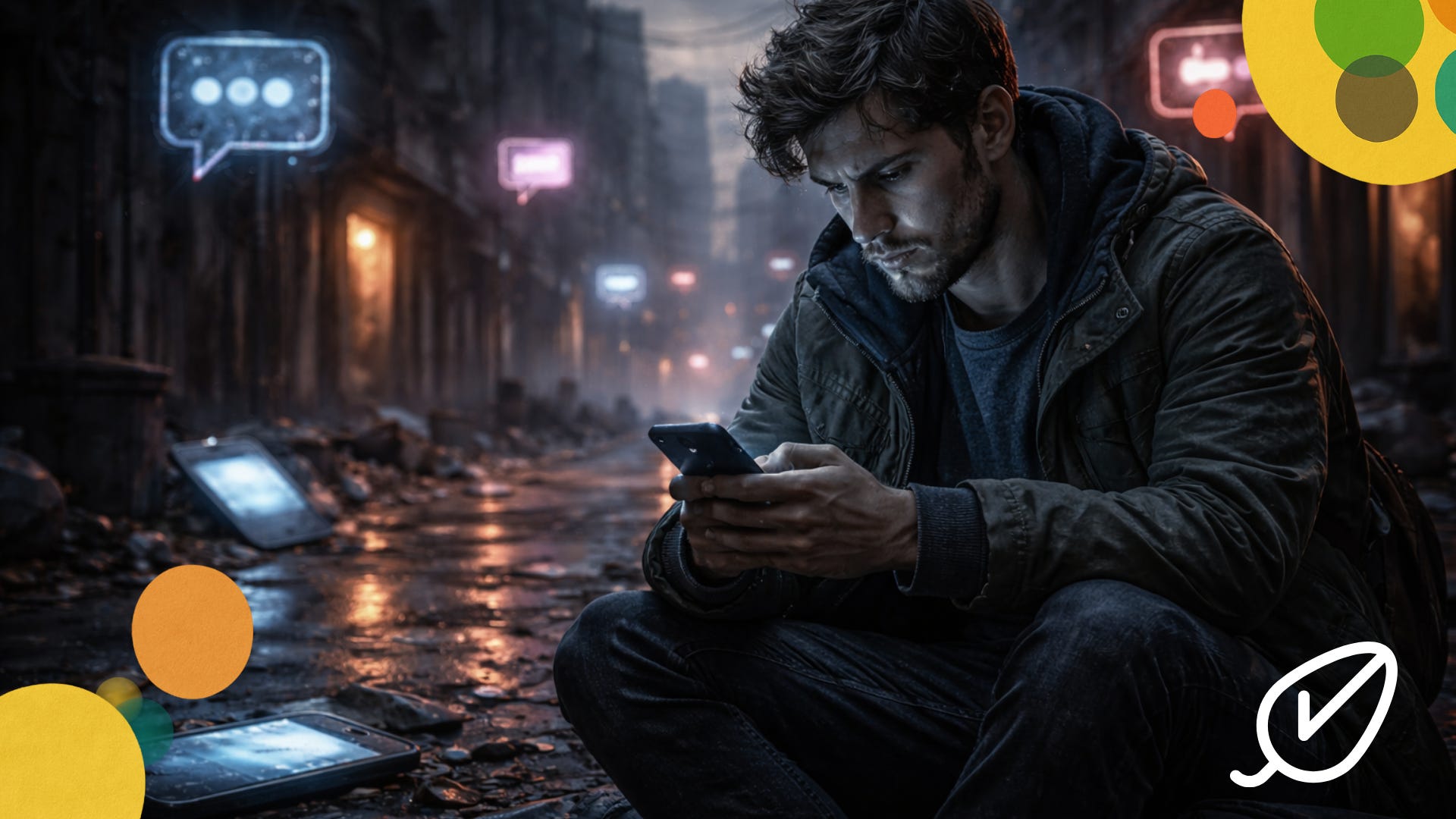
I used to wake up, reach for my phone, and feel a sense of curiosity. It was that early-2010s optimism---the feeling that the world was a sprawling, slightly chaotic dinner party where you might stumble into a joke, a long-lost friend’s vacation photo, or a weirdly heated debate about a niche hobby.
But lately, that curiosity has been replaced by a familiar, low-grade dread. Opening a social media app now feels like walking into a room where everyone is already screaming. Even if you are not the target, the air is thick with the scent of a fight about to happen. We’ve called this “toxicity” for years, but that word has lost its teeth. We assumed the internet got meaner because people got meaner. But a recent study of nationally representative data suggests something much more structural—and much more lonely—is actually happening.
The “vibe shift” isn’t just in our heads nor that the entire world suddenly lost its mind. The shift is happening because the “normal” people are quietly leaving the building.
For years, we operated under the assumption that social media was an ever-expanding digital commons. The data from the study tells a different story. For example, social media platform use is actually in a state of gradual contraction. The “bookends” of our society—the youngest users who set trends and the oldest cohorts who used to anchor family groups—are stepping away at the highest rates. Between 2020 and 2024, legacy platforms like Facebook, Instagram, and the platform formerly known as Twitter all lost significant ground. What we are left with now is actually not a representative sample of humanity but a concentrated extract of the most intensely polarized people on the planet. Try logging on your X account of late. Twitter/X has reached its peak toxicity. If you want to deteriorate your mental health and hope for humanity, open an X account.
The decline in social media is also felt in my own digital life. My Facebook feed used to be a cluttered mess of high school acquaintances and distant cousins. Now, it’s a ghost town occasionally interrupted by a political firebrand and sexually explicit reels. The “casuals”—the people who just wanted to share a sunset or a funny observation—have largely retreated to the shadows of group chats or private DMs.
Some, like myself, want to post as a response to all the political mess in the world but restricted due to our professional affiliations and standing. Some don’t even bother to post because they fear they might be living in a “Police” state---thanks to corporations like Palantir Technologies.
Research from Petter Törnberg confirms this: while overall use is down, the people who stay and post are those driven by “affective polarization.” That is the academic way of saying they don’t just disagree with the “other side”—they actively despise them. They are the far right or the far left. In 2024, the strongest predictor of whether someone is active on social media is not their interest in news or their desire for community but how much “moral heat” they feel toward their political enemies.
This creates a terrifying feedback loop. When the moderate, the tired, and the casual users stop posting, they take the “social” out of social media. They were the bystanders who served as a silent check on bad behavior. In a crowded room, you are less likely to scream an insult if you know fifty people are watching who think you are being a jerk. But as those fifty people leave, the room shrinks. Eventually, the only people left are the two people screaming at each other and a handful of partisans egging them on.
The “social cost” of being toxic disappears because the only audience left is the one that rewards your rage. My own desire to share anything meaningful has plummeted because I feel like I’m performing for an audience that is only looking for a reason to be offended.
The data on Twitter (now X) provides a jarring case study of this collapse. Since 2020, the posting demographic there has undergone a radical flip—a nearly 50% point swing from Democratic-leaning activity to Republican-leaning activity. But the partisanship isn’t the core issue here; it is the intensity. Whether the crowd is red or blue, the mechanism is the same: the system now selects for commitment mixed with anger. We are no longer looking at a public sphere of ideas but looking at a stage for signaling. When I see a trending topic now on X, I don’t see a conversation. I see two opposing phalanxes of users throwing rhetorical bricks at each other, not to convince anyone, but, unfortunately, to prove to their own side that they are the loudest and the ‘purest.’ How sad!
This is why “civility” has become a pipe dream. You can’t ask for civility in a room where the only people who haven’t left are the ones who find civility boring or treasonous. The “peak toxicity” we are experiencing is not just a result of bad content moderation rules. In fact, it is a result of a demographic collapse. We have lost the “behavioral middle.” We have lost the people who would chime in with a joke to break the tension, or the people who would post something so mundane it reminded everyone that there is a world outside of the culture wars. Without that buffer, every single post carries a massive weight of violence and abuse. A simple observation about a movie becomes a proxy battle for your entire identity. A case in point is the documentary Melania, which has further divided the left and right.
There is a brilliant observation to be made about the feeling of the modern internet: even as total posting declines, the experience feels like a flood.
Think of it this way. So imagine if you have ten gallons of water in a swimming pool, it is nothing. If you have ten gallons of water in a closet, you are drowning. The “space” of social media is shrinking as users leave, so the remaining vitriol feels more concentrated, more inescapable. We are being hit with the emotional residue of the few thousand people who are still angry enough to post ten times a day.
So, where does this leave us? If the problem is that the “normal” people have left the room, the solution would not just be better filters or smarter AI, like most of these platforms are proposing. The solution is somehow convincing the exhausted majority that it is safe to come back or finding a new place for them to go.
But the incentive structure of modern tech is diametrically opposed to this. Engagement is the only metric that matters to the bottom line, and nothing engages like moral outrage. As long as “moral heat” is the currency of social media, the platforms will continue to be ruled by the most heated among us.
Personally, I’ve stopped looking for the “commons” on the big platforms. I have moved to smaller niche communities—group chats, Discord servers, Wordpress, and literal dinner tables—where the “bystanders” are still present and the social cost of being a jerk is still high. We have reached “peak toxicity” because we have reached the point where the only ones left in the arena are the gladiators.
The rest of us are just walking out of the stadium, and frankly, I don’t blame us. But until we find a way to make the digital world hospitable for the casual, the quiet, and the moderate again, the tone of online life will only grow sharper and more extreme because the fighters are the only ones left talking, not because more people are fighting.
To halt the demographic collapse of the “behavioral middle,” tech founders must pivot from a growth-at-all-costs engagement model to a retention-based “social cost” architecture. The data proves that as casual users exit, your platform is not just shrinking but mutating into a high-churn reactor of affective polarization that alienates the very users who provide long-term stability.
And while the ultimate fix would be a return to user-owned decentralized spaces, the current profit mandate necessitates a strategic middle ground: The Managed Micro-Commons. Tech founders must intentionally move away from massive open-broadcast feeds and instead architect “sovereign social circles” where community-defined norms recreate the “bystander effect.” Lower the social media platform’s temperature and re-invite the exhausted majority back.