The Algorithm Doesn't Know What a Person Is. The Pope Just Wrote to Remind It.
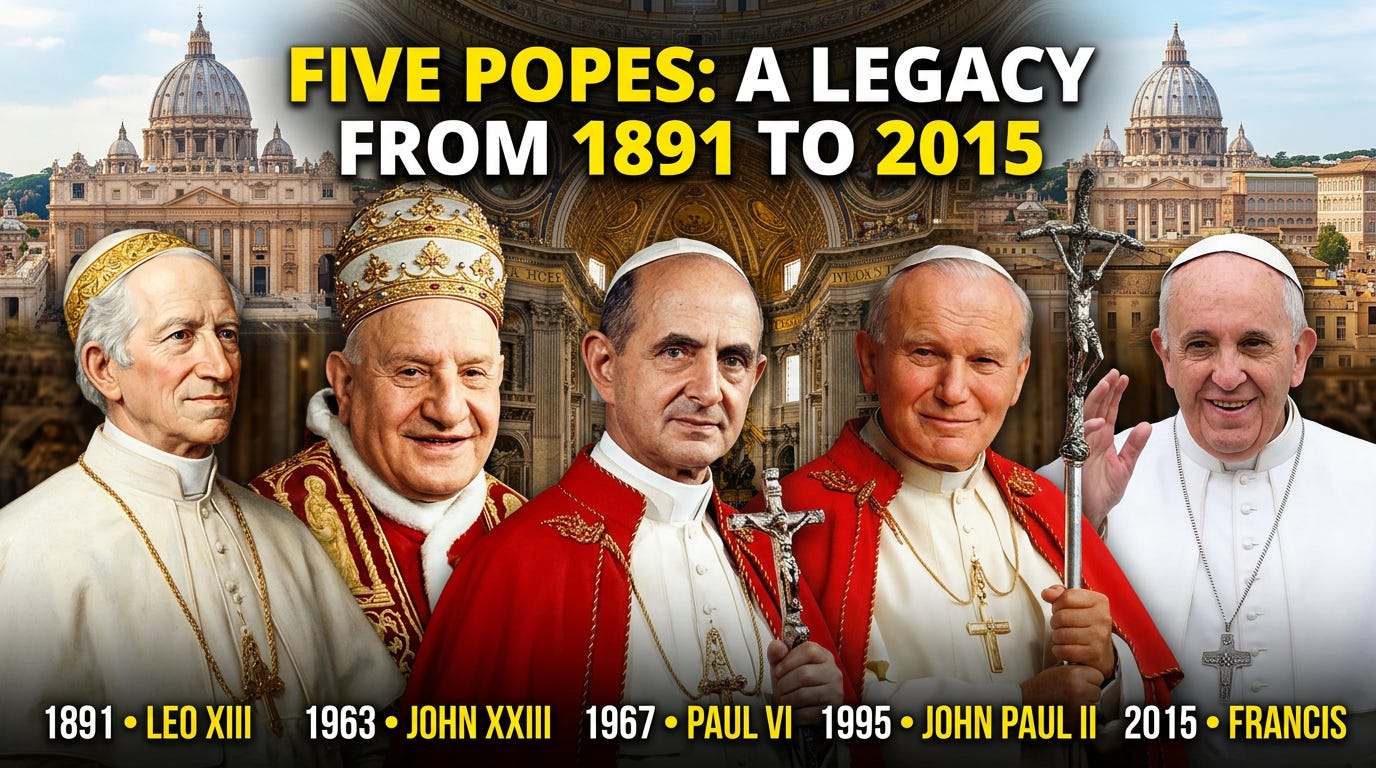
Five popes. 135 years. One steadily widening answer to who counts as fully human. A short reflection on Pope Leo's Magnifica Humanitas as we prepare to meet the age of AI.
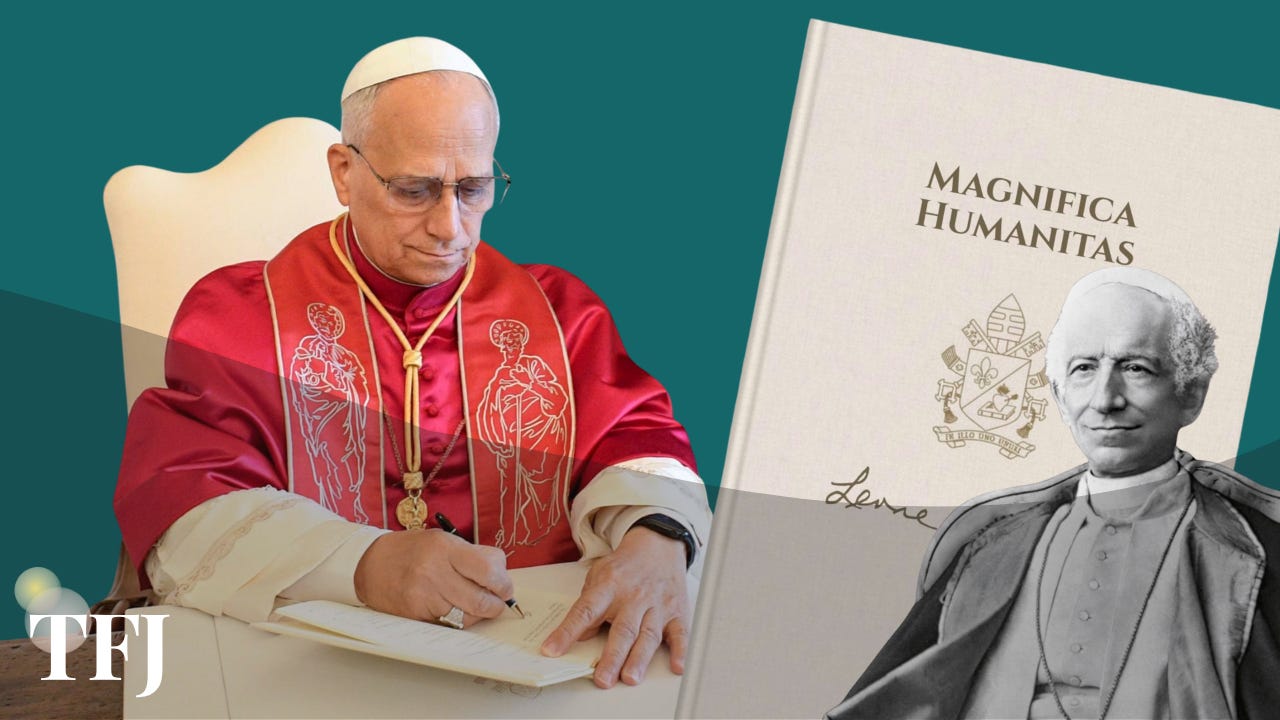
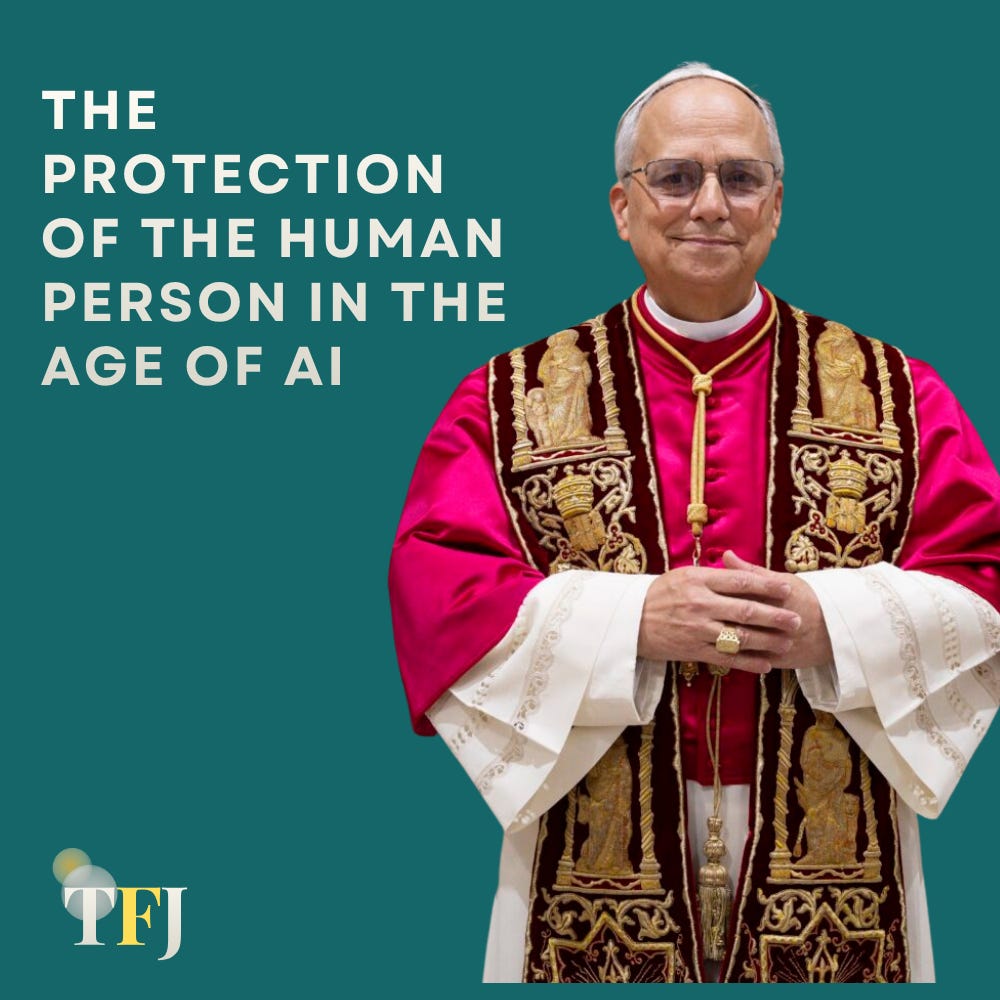
On May 25, 2026, Pope Leo XIV will release his first encyclical, Magnifica Humanitas, on the protection of the human person in the age of artificial intelligence. He signed it ten days earlier, on May 15, exactly 135 years to the day after his namesake, Pope Leo XIII, signed Rerum Novarum, the 1891 letter on the rights of workers in the age of industrial machines. The symmetry is not accidental. Two Leos, two industrial revolutions, the same underlying question: when the machinery of an age threatens to forget what a person is, who will remember on their behalf?
This is the question that has quietly organized one of the most consequential moral traditions of the modern era. Most readers know the encyclicals only by name, if at all. A handful of Latin titles drift through history syllabi and Catholic seminars. But read together, in sequence, they form something more than a religious archive. They form a slowly expanding cartography of the human person, written across 135 years of upheaval, and they have shaped global policy, law, economics, and moral imagination in ways the secular world rarely credits.
Before going further, an honest preface is needed. The Catholic tradition was not always on the right side of this question, and pretending otherwise would falsify the whole argument.
The shadow before the widening
Long before the modern social encyclicals, popes wrote documents that helped underwrite some of history’s gravest violations of human dignity. The bulls Dum Diversas (1452) and Romanus Pontifex (1455) granted Portuguese sovereigns authority to “reduce to perpetual slavery” non-Christian peoples in West Africa, and Inter Caetera (1493) divided the so-called New World between Iberian crowns, helping to seed the legal architecture later called the Doctrine of Discovery. These texts did not invent colonialism or the Atlantic slave trade, but they baptized them. Centuries later, when the Holocaust unfolded in Christian Europe, the Vatican’s diplomatic caution, however it is finally judged, made clear that papal voice and papal silence each carry historical weight. Modern Catholic social teaching is, in part, a long act of moral self-correction by a tradition that learned, painfully and incompletely, that its understanding of the human person had been too narrow. The widening that begins in 1891 is not a triumphal arc but a tradition working out, in public and in writing, who it had been failing to see.
That context is what makes the modern encyclicals readable as an argument rather than a settlement. They are not pronouncements from a tradition that always knew. They are revisions from a tradition that was learning, and that kept widening the circle of the person each time history forced a new question.
Each major social encyclical of the modern era added a new figure to the answer of who counts as fully human. The worker. The citizen. The developing person. The vulnerable life. The ecological self. And now, in 2026, the person under the gaze of the algorithm.
Five widenings, but one tradition
The pattern is easier to see when the documents are placed in chronological order and read for the figure each one defends. What follows is not a complete summary of the encyclicals. It is a portrait of the human person, drawn in five movements.
1891 · Leo XIII
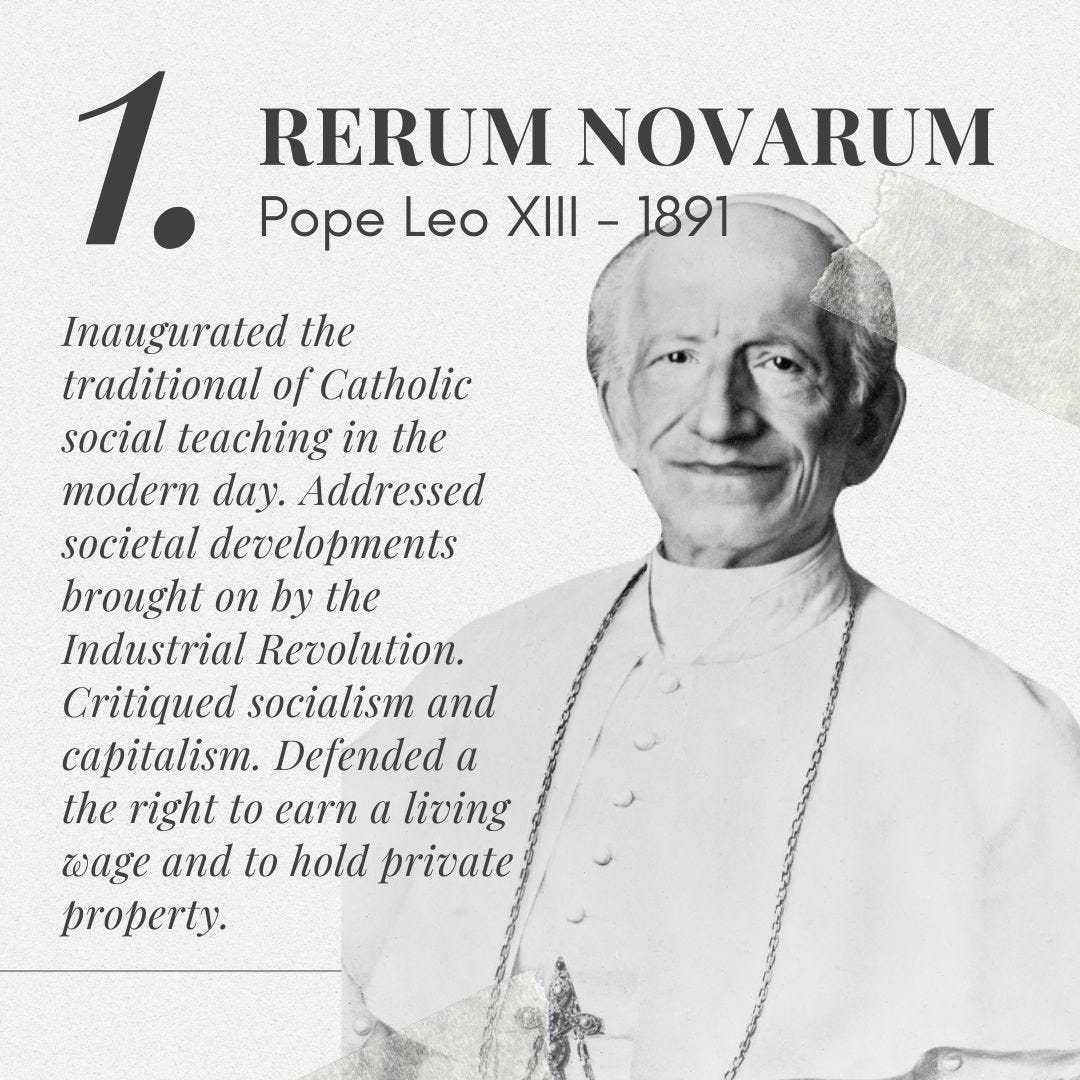
Rerum Novarum
The worker becomes a person.
Photo credit: Joan Sloan Peters
Industrial capitalism had reduced human beings to inputs in a production system. Leo XIII defended labor dignity, just wages, private property as a buffer against exploitation, and the right of workers to organize. He rejected both unrestrained capitalism and revolutionary socialism, refusing the binary that was tearing Europe apart. The encyclical seeded modern labor law, Christian democracy, the welfare state, and trade union ethics across Europe and Latin America. It was the first time the modern papacy said, in effect: the person on the factory floor is not a cost.
1963 · John XXIII
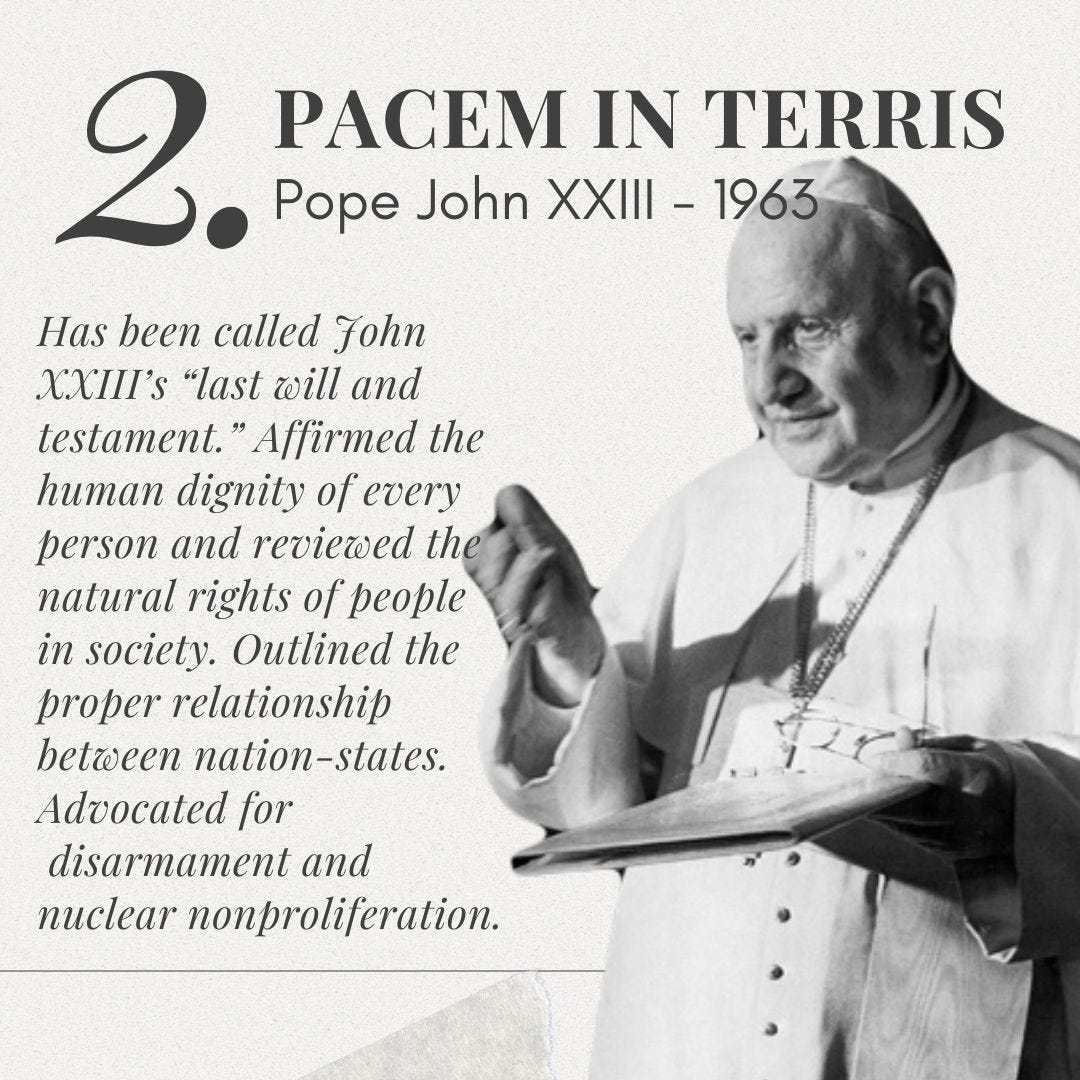
Pacem in Terris
The citizen becomes a global person.
Photo credit: Joan Sloan Peters
Written months after the Cuban Missile Crisis, when the world had stood within hours of nuclear exchange, John XXIII extended Catholic social thought into the geometry of international relations. The encyclical insisted that human dignity does not stop at borders, that peace is not the absence of war but the presence of justice, and that nuclear weapons threaten not only enemies but the human family itself. It anticipated later global human rights instruments and made the Church a moral voice in diplomacy, peacebuilding, and the postwar world of international ethics.
1967 · Paul VI
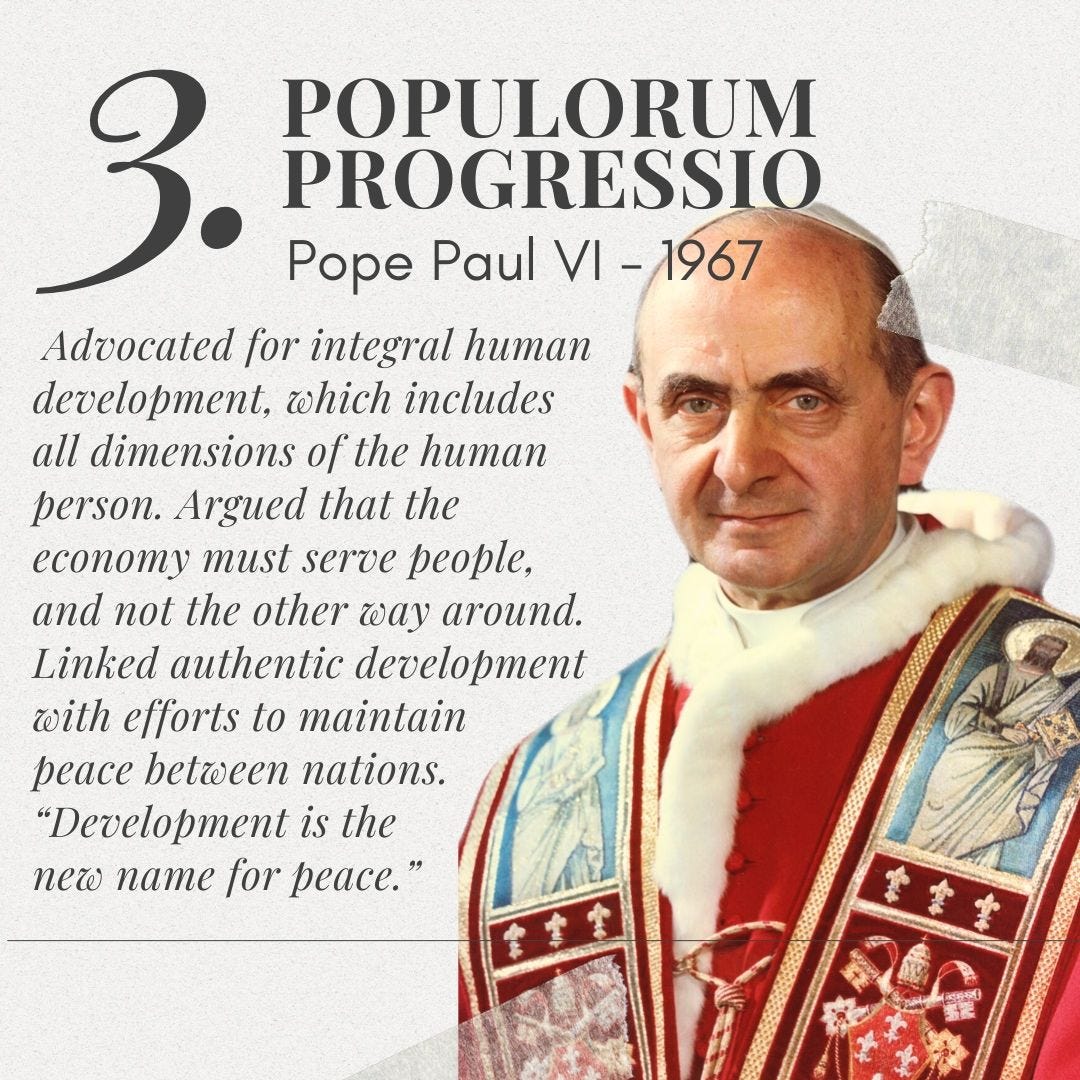
Populorum Progressio
The developing person becomes the measure of peace.
Photo credit: Joan Sloan Peters
As former colonies sought self-determination and Cold War powers competed for influence in the Global South, Paul VI delivered the line that reorganized Catholic development ethics: development is the new name for peace. Economic growth without the whole person, he argued, is not progress. The encyclical introduced “integral human development,” a concept that would later shape Catholic development agencies, liberation theology in Latin America, emphasis on quality of life in academia and public policy, and global humanitarian frameworks. It refused the postcolonial settlement in which the West counted as developed and everyone else counted as catching up.
1995 · John Paul II
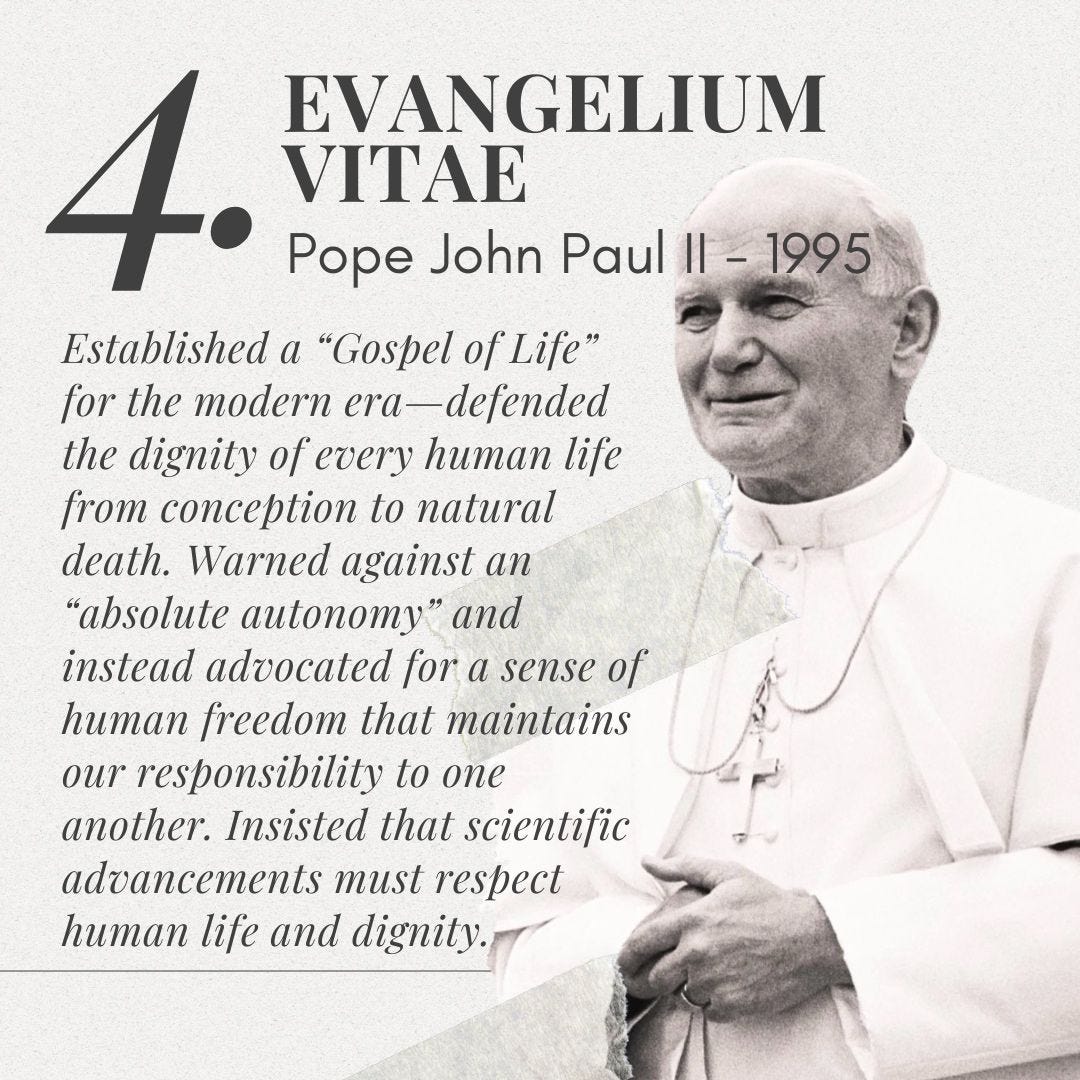
Evangelium Vitae
The vulnerable life becomes the test of dignity
Photo credit: Joan Sloan Peters
By the late twentieth century, biotechnology, autonomy discourse, and consumer individualism were redrawing the boundaries of personhood at both ends of life. John Paul II named the cultural pattern a “culture of death” and argued that a civilization which cannot defend its weakest members has already conceded the question of dignity. The encyclical reshaped global pro-life ethics, but its deeper claim was much more structural, arguing that the worth of a society can be read in how it treats those who cannot defend themselves. That argument continues to organize bioethics debates from end-of-life care to gene editing.
2015 · Francis
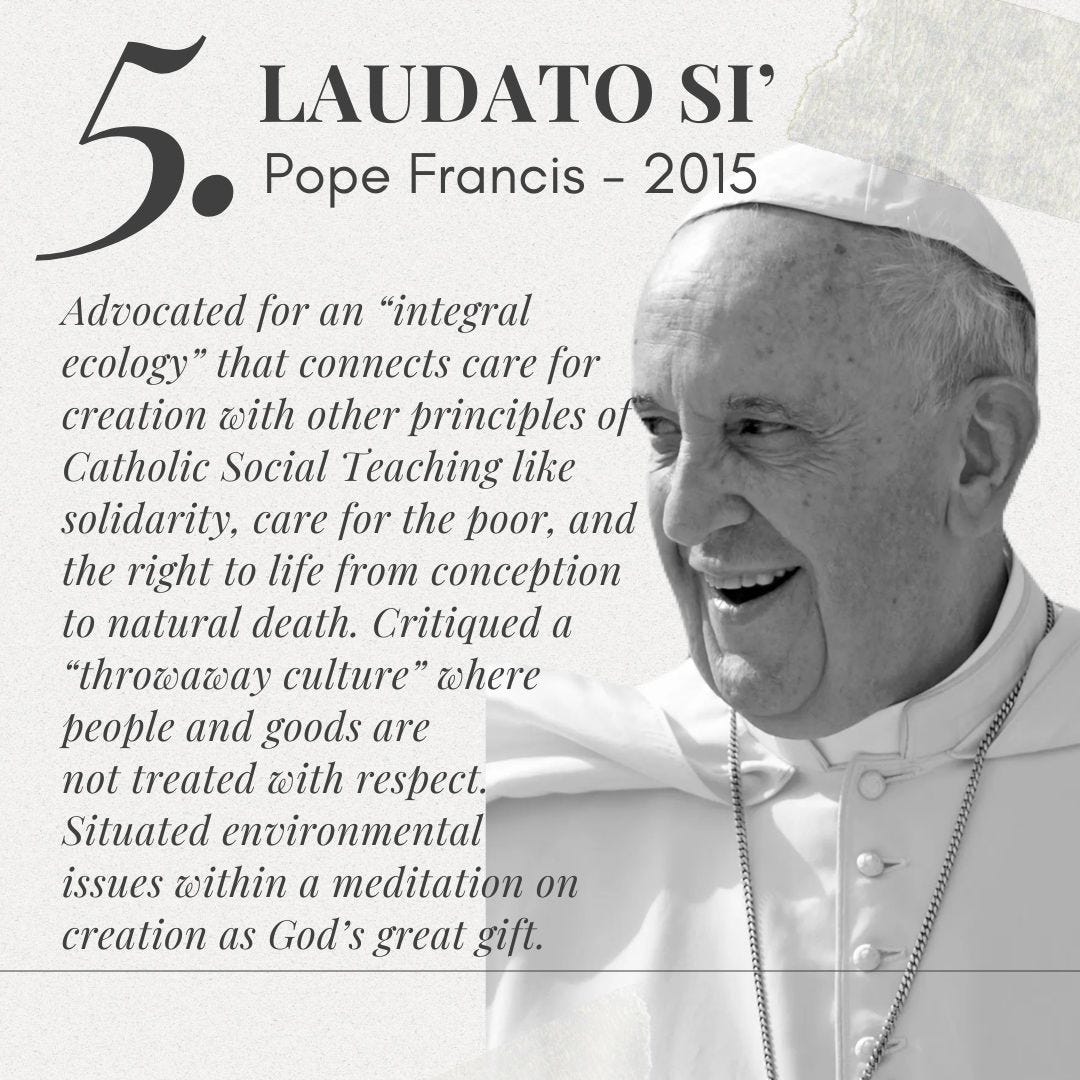
Laudato Si’
The person becomes ecological.
Photo credit: Joan Sloan Peters
Francis made a move the tradition had not made before. He argued that the human person cannot be understood apart from the earth, the poor, and the systems that connect them. The encyclical’s signature concept, integral ecology, fused environmental, economic, and spiritual crisis into a single moral horizon. The text influenced climate ethics, faith-based environmental activism, and the moral framing of the COP negotiations. It also widened Catholic anthropology in a way that drew on long Indigenous and contemplative traditions: the person is not a sovereign individual standing above creation but a relational self woven into it.
The Pattern
Worker. Citizen. Developing person. Vulnerable life. Ecological self. Each encyclical did not replace the previous figure. It added one. The human person, in this tradition, has been growing in complexity for 135 years.
The sixth widening
This is where Pope Leo XIV comes into the picture. The announced focus of his Magnifica Humanitas is the protection of the human person in the age of artificial intelligence. The Vatican has emphasized that the document was deliberately signed on the anniversary of Rerum Novarum, and the parallel is exact in its structure. In 1891, industrial machinery had begun to absorb human labor, making the worker invisible inside the system that consumed them. In 2026, algorithmic systems are beginning to absorb human judgment, attention, relationship, and even creative voice, in ways that make the person inside the data flow harder to see.
If the pattern holds, Magnifica Humanitas will not simply moralize about technology. It will name a new figure in the long widening: the person under algorithmic gaze, whose dignity is being quietly redefined by systems they did not consent to and cannot fully see. Whether the encyclical succeeds in this is a question for next week and the years that follow. But the timing makes clear that Leo XIV understands himself to be standing at a hinge moment of the same kind Leo XIII faced in 1891.
When the machinery of an age threatens to forget what a person is, the question becomes who will remember on their behalf.
What the encyclicals were building
Read sequentially, the social encyclicals form something the modern world has rarely had: a publicly written argument that the human person is irreducible to any single dimension or world order. Not labor alone. Not citizenship alone. Not economic development alone. Not autonomy alone. Not even relationship to the earth alone. The person is all of these at once, and any age that loses sight of one of them is failing the whole.
Dimension One
Dignity
The person has intrinsic worth that no economic, political, or technological system can reduce or assign.
Dimension Two
Solidarity
Persons are made through relation. The flourishing of one is bound to the flourishing of all, across borders and generations.
Dimension Three
Subsidiarity
Decisions belong at the level closest to the persons affected. Centralized power that bypasses local life is itself a kind of harm.
Dimension Four
Common Good
A society is judged not by its averages but by the conditions it creates for every person to flourish, especially the most vulnerable.
Dimension Five
Integral Ecology
The person is not sovereign over creation but situated within it. Place, body, and ecosystem are constitutive of who we are.
Dimension Six
Transcendence
Human flourishing is not a closed system. It opens toward meaning, mystery, and the goods that no market can manufacture.
These are not abstract principles. They are the deposit of 135 years of writing in response to specific historical pressures, and they have shaped global policy in ways that are easy to overlook precisely because they have become ordinary. The architecture of postwar human rights, the language of integral development used by UN agencies, the moral grammar of the climate movement, the categories used in global poverty frameworks, the bioethics consensus around vulnerable populations: each of these owes more to Catholic social teaching than most secular accounts acknowledge.
The flourishing lineage
This is where the contemporary science of human flourishing meets a tradition older than itself. In the last fifteen years, flourishing has become a measurable construct. The Global Flourishing Study, the longitudinal collaboration between Harvard’s Human Flourishing Program and Baylor’s Institute for Studies of Religion, is now generating data on more than 200,000 participants across 23 countries, examining how dimensions of life, including meaning, relationships, character, health, and material conditions, hold together across cultures. My own work on the Relational Theory of Hope and on relationships, place, and integral flourishing sits inside that broader empirical project.
What the encyclicals offer, read in this light, is the moral cartography that the empirical science is now beginning to investigate. Long before flourishing became a construct one could measure, this tradition had been articulating, in public and in revision, a multidimensional vision of the human person grounded in dignity, solidarity, work, peace, vulnerability, place, and transcendence. The science is catching up to a vision the tradition had already widened, encyclical by encyclical, into something our current world badly needs and rarely names.
A Closing Thought
The encyclicals are not finished documents. They are a tradition writing itself toward a fuller view of the human person, often in response to the very technologies and systems that threaten to narrow it. Each generation has had to widen the answer again, because each age finds new ways of forgetting who a person is.
What Magnifica Humanitas will add to that genealogy, we will know soon. What the tradition makes clear, already, is that the flourishing of persons is too large a question to leave to any single discipline, market, or machine. It belongs to all of us. It has always belonged to all of us. The encyclicals have simply been keeping the receipts.