

The City Promised Them Everything. The Data Say It Is Delivering Almost Nothing.
Young adults aged 18 to 24 are among the least city-satisfied groups on earth — in the very cities designed, marketed, and culturally narrated for them. Global Flourishing Study data across 22 countri

Every generation of young adults has arrived in cities with expectations. That is not new. What is new is the scale and the degree to which contemporary culture has constructed the city as the singular destination of young adult aspiration, the place where real life begins, where identity is formed, where the future is made. Social media has accelerated this narrative to the point where the city is not merely a place young people move to. It is a promise they have been handed since adolescence. And the Global Flourishing Study data, drawn from 22 countries and tens of thousands of respondents, now allow us to assess, with some clarity, how that promise is being kept.
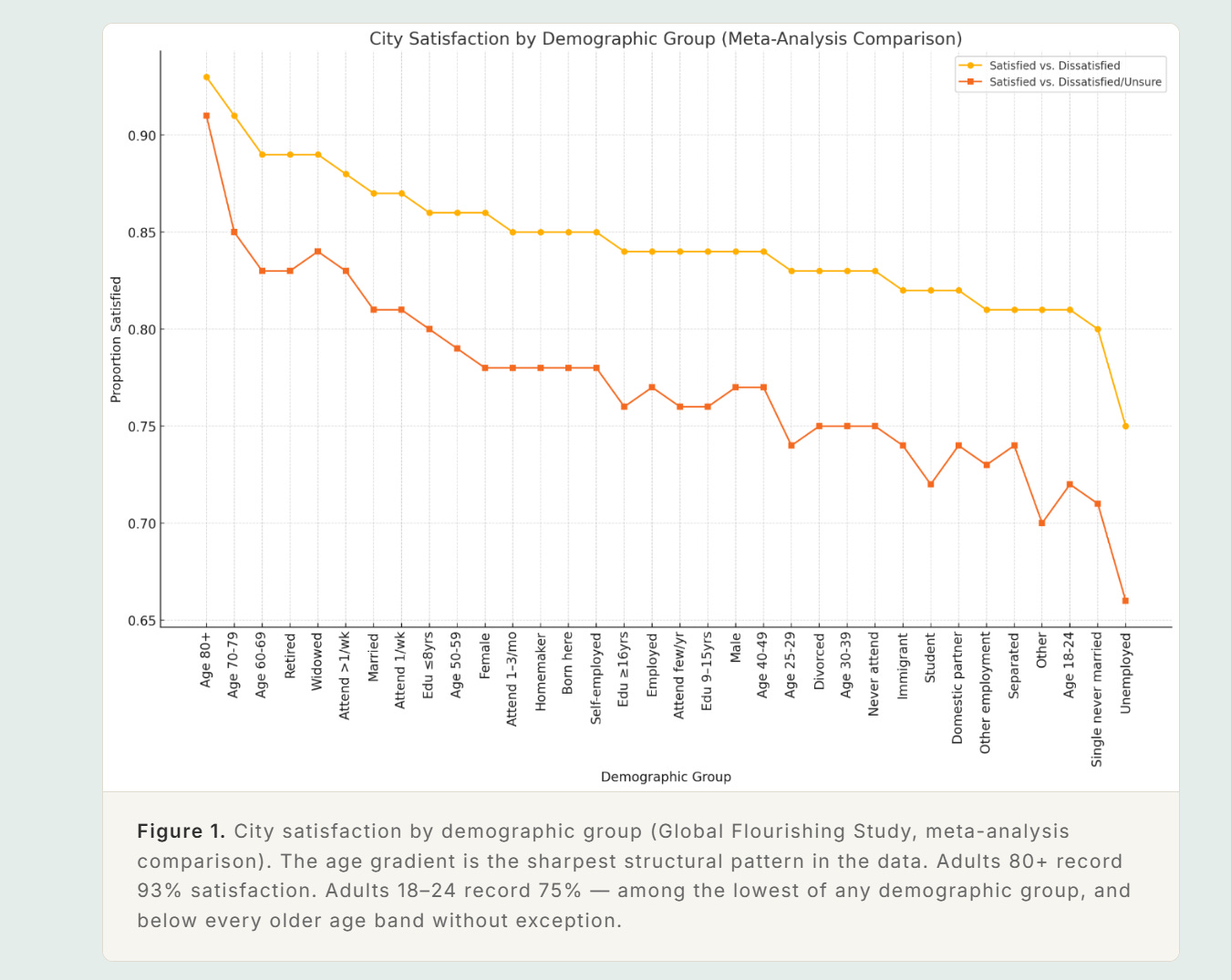
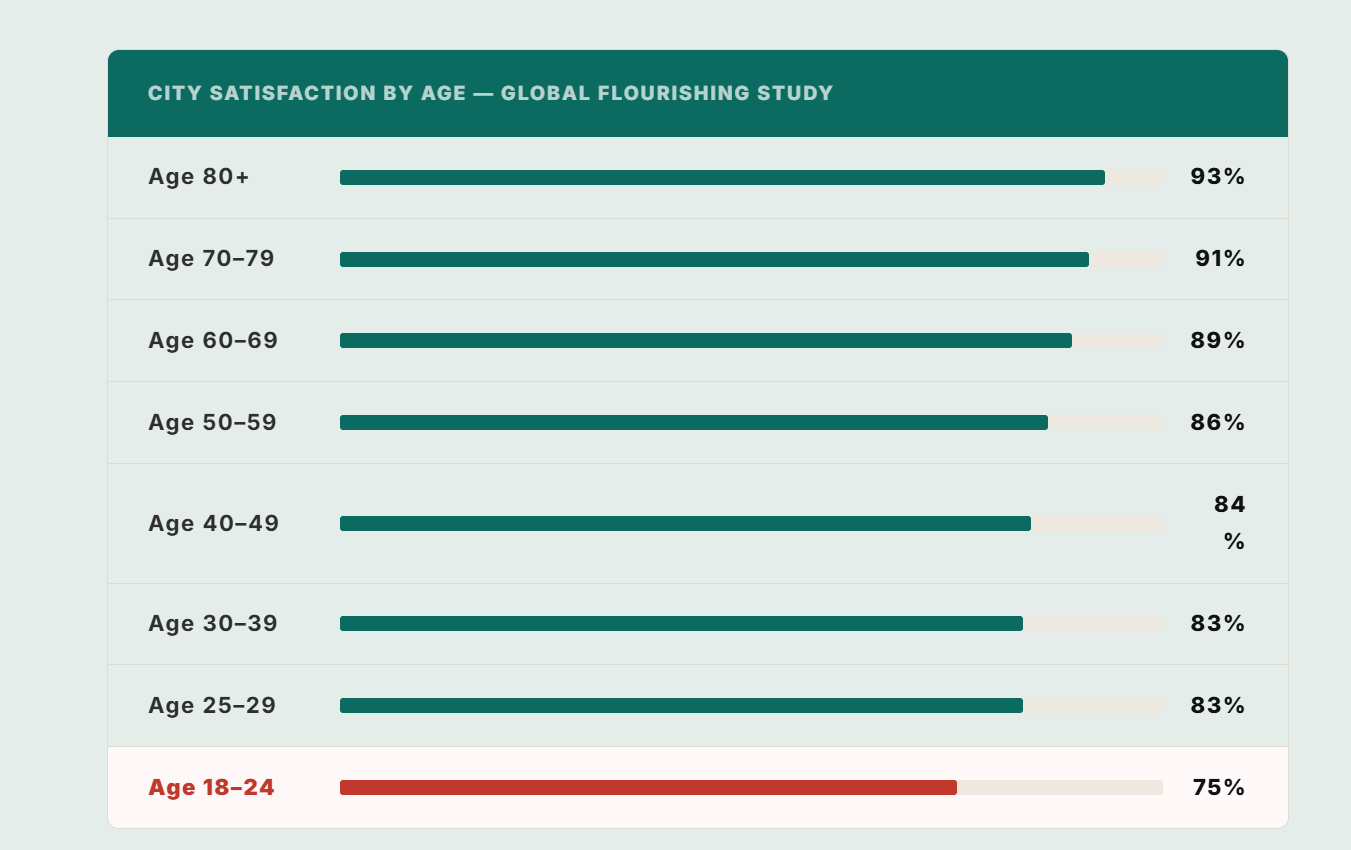
The answer is not encouraging. Adults aged 18 to 24 report city satisfaction at 75% — the lowest of any age group in the study, and 18 percentage points below adults aged 80 and above, who are the most city-satisfied demographic on earth. This is the generation that cities are most visibly designed for — the rooftop bars, the co-working spaces, the curated neighbourhoods, the cultural programming aimed squarely at the young professional demographic. And they are the generation least satisfied with what those cities are delivering. That gap between design intention and lived appraisal is what this article is about.
Satisfaction is a ratio and the ratio is broken
Place satisfaction is not a raw assessment of environmental quality. It is a relationship between experience and expectation — between what a place delivers and what a person anticipated it would deliver. A city that performs adequately against calibrated expectations produces satisfaction. A city that performs adequately against inflated expectations produces dissatisfaction. And one of the most consequential things that has happened to young adults in the past two decades is an extraordinary inflation of urban expectation, driven by a media environment that curates cities relentlessly and omits almost everything that makes them hard
.
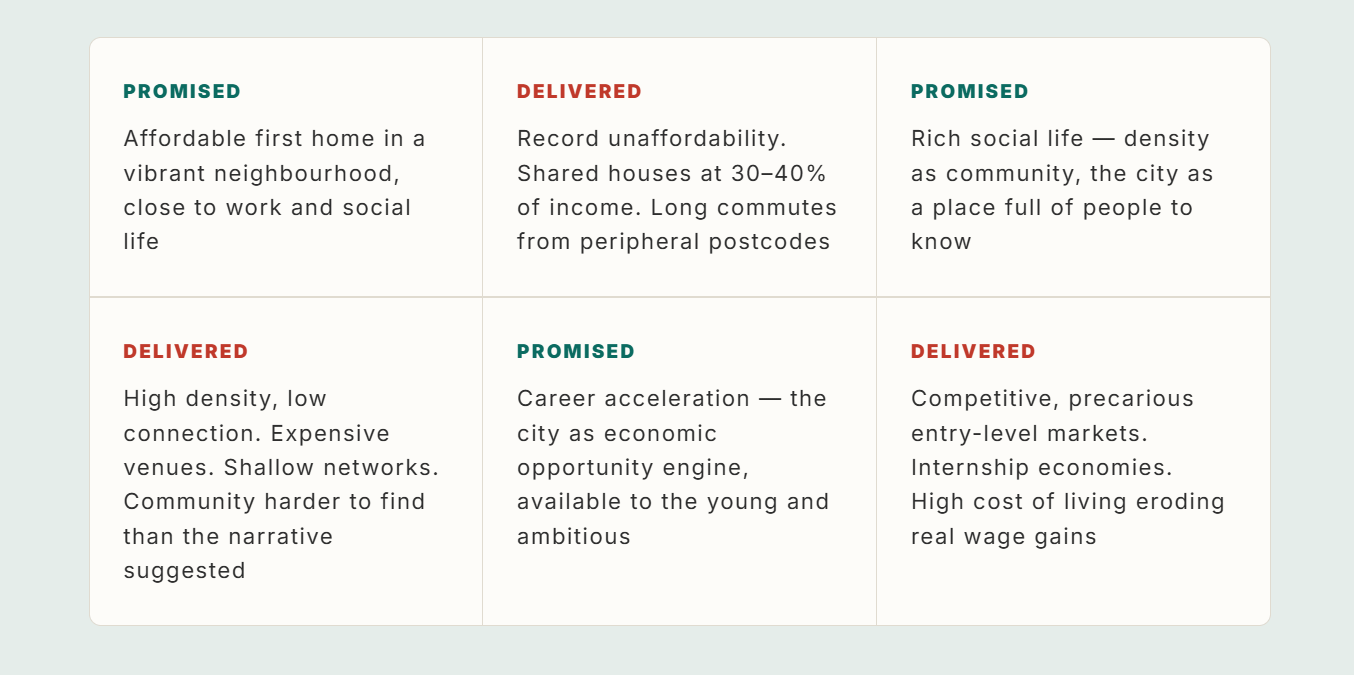
The 18-to-24-year-old arrives in a city having consumed years of carefully edited representations of it — the highlight reel of urban life, with the housing search, the loneliness, the cost, and the grinding transience largely absent. The expectation is formed against an image. The experience lands against a reality. The appraisal reflects the distance between them
.
This is not a counsel of pessimism about cities. I am simply trying to lay out an observation about the asymmetry between how cities are narrated to young people and how young people actually experience them. The 75% satisfaction score is not evidence that cities are failing in absolute terms but points to an evidence that the promise substantially exceeds the delivery and that young adults are the demographic most exposed to that gap. This is, partly, because they are the ones who arrived with the largest expectation and the least accumulated experience to calibrate it against.
Transience as a place satisfaction killer
Young adults aged 18 to 24 are the most mobile demographic in most societies. They move for university, then for entry-level employment, then for better opportunities, then for relationships, then for housing affordability in whatever city has become unaffordable in the one they started in. This relocation frequency is not incidental to their low place satisfaction scores. It might be structurally causal–and I will tell you why I say that
Place satisfaction, the research consistently shows, deepens with residential duration. The familiarity with local rhythms, the accumulated knowledge of neighbourhood geography, the gradual formation of local social ties, the sense of having history in a place — all of these are products of time spent in a specific location. They cannot be downloaded. They cannot be rushed because they require presence, repetition, and the kind of unhurried accumulation that frequent relocation structurally prevents.
“The young adult who moves every eighteen months is not building a relationship with their city. They are sampling it. And sampling, however wide-ranging, does not produce the depth of appraisal that long residence generates.”
The 80-year-old who scores 93% on city satisfaction has almost certainly lived in their neighbourhood for decades. They know it in the way that only time teaches. The 22-year-old who scores 75% arrived recently, plans to leave when the opportunity presents itself, and is inhabiting a city they have not yet had time to learn. The difference in satisfaction is not only a difference in what the city is providing. It is a difference in how much of the city has been allowed to accumulate into the person’s experience of it
.
Digital displacement and the fractured experience of place
There is a dimension of the young adult’s relationship to place that has no historical precedent and that the existing literature on place satisfaction has only begun to grapple with. Adults aged 18 to 24 are the most digitally present generation in history. They conduct significant portions of their social lives, their professional lives, their leisure, and their self-presentation through screens — and those screens are, spatially, nowhere in particular.
This matters for place appraisal because satisfaction with a place requires actually inhabiting it — attending to it with sufficient presence to form a meaningful evaluation. A person whose attention is distributed across a dozen digital environments simultaneously is not fully inhabiting any physical one. The neighbourhood is experienced through a phone as much as through the street. The local park is a backdrop for a photograph rather than an environment to be known. The city is something scrolled past as much as something walked through.
This is not a moral argument about screen time. It is an observation about the conditions under which place satisfaction forms. Appraisal requires presence. And sometimes, this presence requires attention. And the attentional economy of contemporary young adult life is structured in ways that systematically pull attention away from the immediate physical environment toward the mediated, the curated, and the elsewhere. The 75% satisfaction score may in part be measuring what the young adult is no longer fully present enough to receive and not necessarily what the city is failing to deliver.
The country-level picture adds a further layer
The demographic data do not exist in isolation. The country-level findings from the Global Flourishing Study add an important comparative layer. The countries with the highest city satisfaction scores — the Philippines, Indonesia, India — are not the countries most associated with the youth-oriented and digitally saturated urban culture that characterises cities in the global north. They are countries–in the global south—where local community structures, religious institutions, and intergenerational neighbourhood ties remain stronger, and where the narrative promise of the city has not been as comprehensively inflated by social media and aspirational marketing.
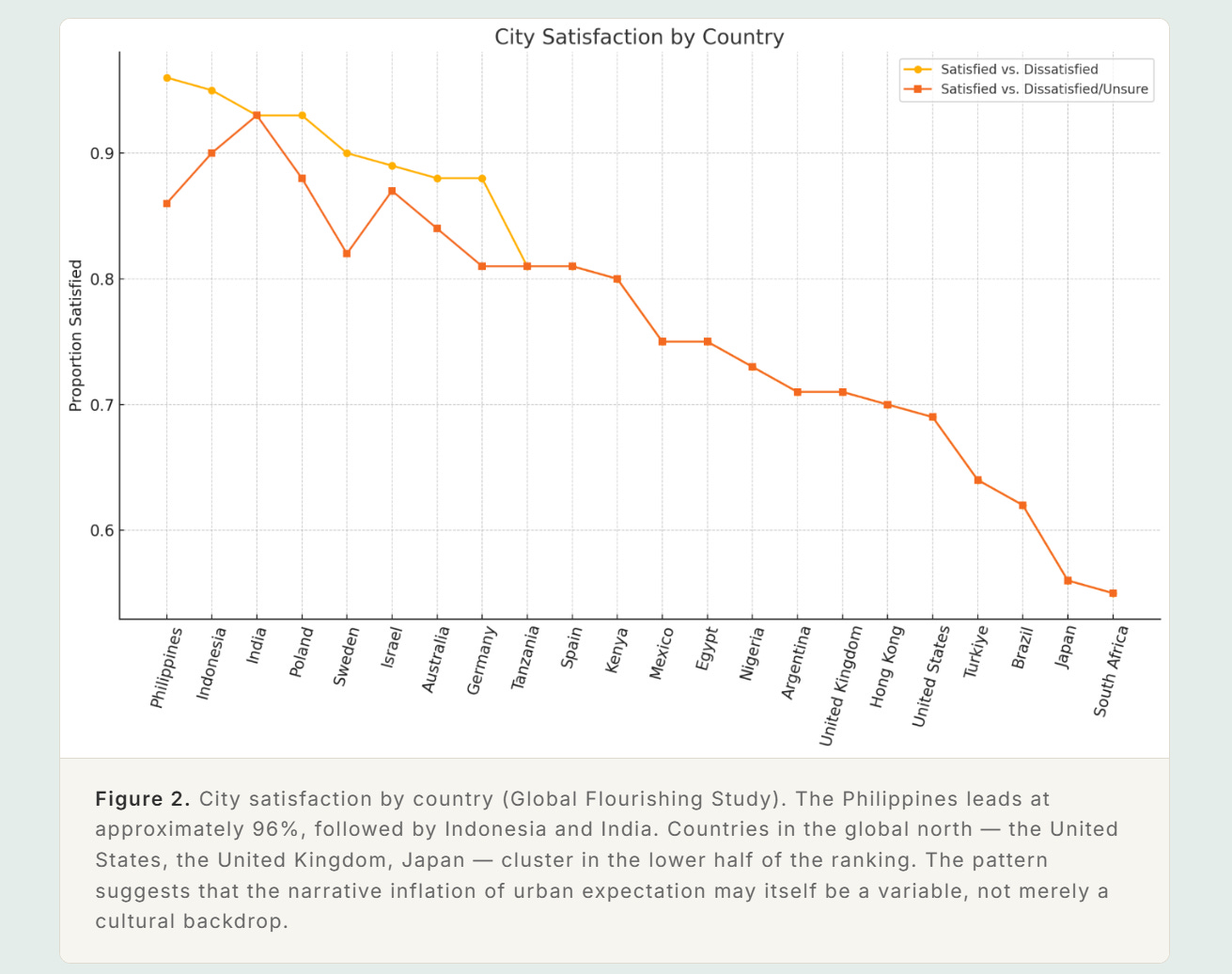
Countries in the global north — the United States, the United Kingdom, Germany, Australia — cluster in the middle and lower portions of the country ranking. These are precisely the countries where the promise of the city has been most aggressively narrated, most comprehensively marketed, and most thoroughly embedded in the aspirational culture that shapes young adult expectations. They are also, not coincidentally, the countries with the most severe housing affordability crises for young adults. The country-level data do not simply reflect objective urban quality. They reflect the size of the gap between what was promised and what was found.
What cities owe the young and are not providing
The policy reflex when confronted with young adult urban dissatisfaction is typically to propose more — more amenities, more nightlife, more cultural programming, more co-working infrastructure. More of the things that cities are already providing in abundance, under the assumption that the problem is quantity rather than kind.
The Global Flourishing Study data suggest the problem is more fundamental. The features that produce the highest city satisfaction across the entire demographic spectrum — as demonstrated most clearly the 80+ finding — are not amenity-driven. They are stability-driven: walkable scale, residential affordability, long-term community anchors, local institutions that outlast a lease cycle, and the conditions under which place familiarity can form and grow over time. These are precisely the features that contemporary cities systematically under-provide for young adults, who are instead offered transience dressed as freedom and density dressed as community.
What cities invest in for young adults: cultural programming, entertainment districts, co-working spaces, short-term rental supply, transit optimised for commuting patterns.
What produces high place satisfaction: residential stability, walkable neighbourhood scale, long-term community activities, local institutions that persist across years, the conditions under which place familiarity accumulates.
The gap between those two lists is a significant part of what the 75% satisfaction score is measuring.
The city that works for the over-80s — legible, local, stable, relationally situated — is the city that young adults need in order for place satisfaction to form. It is not the city being built for them. And until the gap between the city that is promised and the city that is built begins to close, the data are unlikely to move.
Young adults are not asking too much of their cities. They are asking what they were told to ask. The problem is that cities, for all their investment in youth-oriented design, have not yet reckoned seriously with what it would actually take to make young people feel at home in them. The Global Flourishing Study data make that reckoning harder to avoid. 75% percent is not a crisis, but a signal to something happening unnoticed. And signals, if attended to early enough, are more useful than crises.