

The Mercy of a Roof: 106 Degrees, and Nowhere to Go
America's deadliest weather does not make for dramatic television. It arrives without wind or siren, and it kills the people we have already stopped seeing.

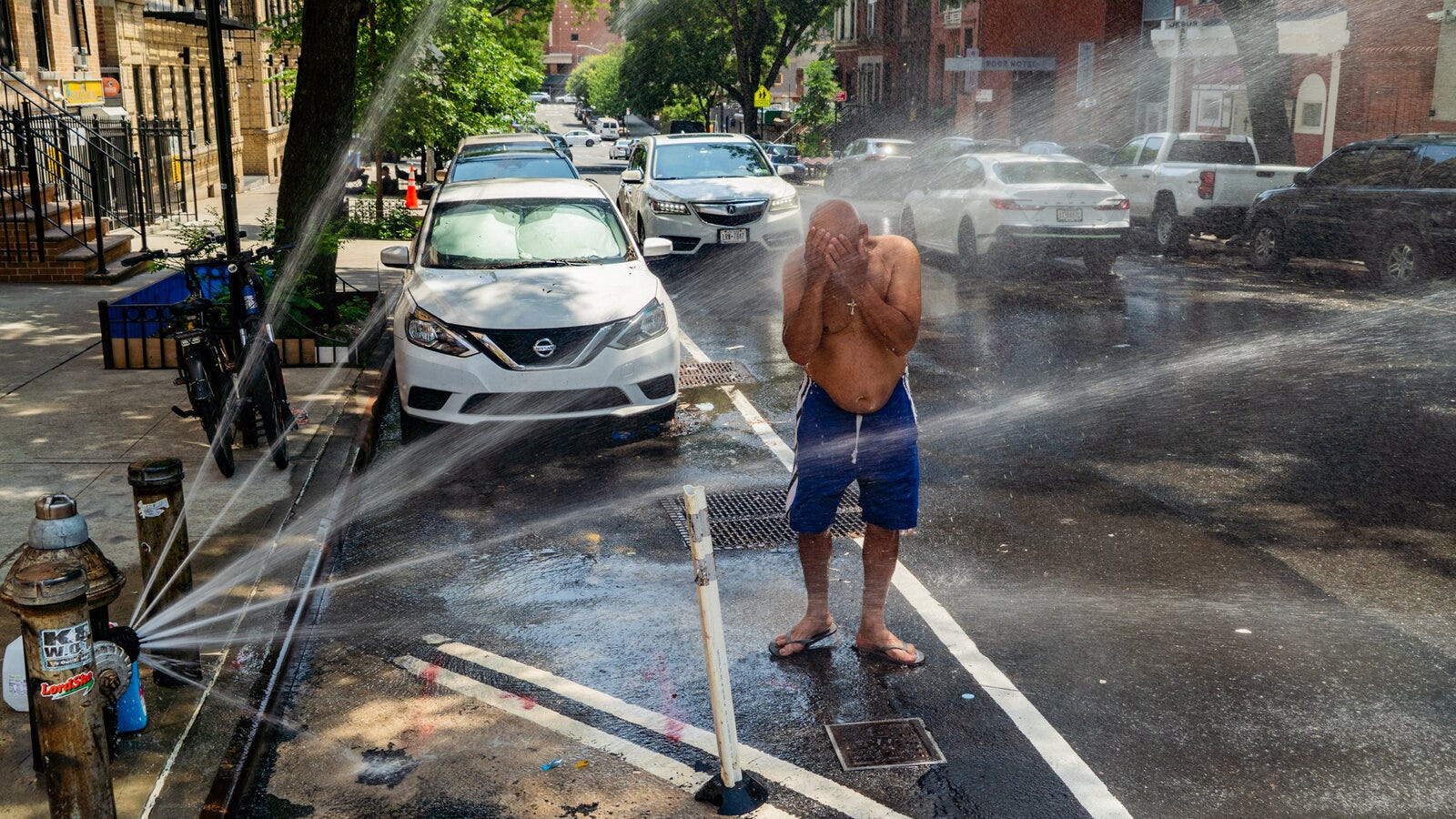
On the 4th of July, Atlantic City reached 106 degrees, a record for the city. By nightfall the boardwalk had thinned, celebrations up and down the coast had been trimmed or cancelled, and the concrete under the casinos was still releasing the afternoon back into the dark. On that concrete, people slept literally. Men and women with names, some of them within sight of ten thousand air-conditioned hotel rooms.
The heat dome that settled over the eastern United States this week placed millions of Americans under advisories and has killed at least 23 people so far, most of them in New Jersey. In much of the country, overnight temperatures refused to fall below 80. That last figure matters more than the headlines suggest. Because heat kills at night, when the body expects relief and does not receive it. For anyone with a cool room, night is a reset. For anyone without one, the danger compounds hour by hour until the body loses the argument.
The disaster we refuse to name
Heat has been the deadliest weather in America for decades. The National Weather Service counted 529 heat deaths in 2024, more than floods, hurricanes, tornadoes, and lightning combined. Heat-related deaths in this country more than doubled between 1999 and 2023. Yet heat produces no debris field and no rooftop rescue. Its victims die alone, indoors, out of frame, and policy attention has a long habit of following the cameras.
Consider what New York City’s own health department reports. Nearly half of the city’s heat-stress deaths over the past decade occurred inside homes. Among the home deaths where investigators could determine, not a single person had a working air conditioner. A quarter had an electric fan running: a fan pushing 95-degree air across a failing body. A roof, it turns out, is not the same thing as shelter. During a heat dome, an uncooled apartment can be more dangerous than the street it stands on.
Heat kills the way poverty kills: indoors, out of frame, one unwitnessed hour at a time.
Who the heat finds
More than 770,000 Americans are homeless on a given night, according to the federal government’s most recent count, the highest figure ever recorded. This week, outreach teams in New York fanned out by the hundreds to check on unhoused residents; Newark declared a Code Red; Detroit opened its libraries as refuges. These measures save lives, and the workers who run them deserve honor. But they also concede something we prefer not to say aloud: in the world’s richest nation, surviving July can depend on whether charity finds you in time.
The heat is also unevenly distributed, and not by accident. Black Americans die from extreme heat at nearly three times the rate of white Americans, the compound interest of housing policies that concentrated Black families on the hottest and least-shaded blocks of American cities. A window unit runs $300 to $800. In Brooklyn this summer, a 71-year-old retiree applied for a free one through a city program and was told the city had run out. Then the dome arrived.
Some statistics
529 heat deaths recorded nationally in 2024, exceeding floods, hurricanes, tornadoes, and lightning combined
2x increase in U.S. heat-related deaths between 1999 and 2023
3x the death rate from extreme heat for Black Americans compared with white Americans
Nearly half of New York City’s heat-stress deaths over the past decade occurred inside homes, none with a working air conditioner where records existed
Abraham Maslow placed shelter at the base of his hierarchy, beneath belonging, beneath esteem, beneath meaning. The placement was a claim about order and the fact that the higher goods rest on the lower ones. We have inverted his insight. American culture now runs a thriving industry helping the comfortable pursue purpose, optimize habits, and curate meaning, while the base of the pyramid is left to the market to sort out. But nobody self-actualizes at a heat index of 110. Flourishing has a floor, and that floor, for starters, is a cool and safe place to sleep.
I felt the force of this in my own home this week, in the most ordinary way possible: I adjusted a thermostat. It took two seconds and no thought. Somewhere in my own city, in what forecasters called the region’s most significant heat wave since 2012, that same two seconds was the difference between a hard night and a hospital.
Nothing but gratitude
Gratitude is the right response to a roof in July, and on this point the science and the Scriptures agree. Two decades ago, psychologists Robert Emmons and Michael McCullough ran the now-famous counting-blessings experiments: people who kept a simple weekly gratitude list slept better, exercised more, and grew more optimistic. The most telling result came later. In David DeSteno’s lab at Northeastern, people induced to feel grateful gave more time and effort not only to those who had helped them but to complete strangers. The field has slowly settled on a conclusion worth sitting with: gratitude exists for something beyond the pleasant feeling. It is the emotion that turns receivers into givers. A thankful heart that never becomes a helping hand is, by the science’s own measure, an unfinished emotion.
Across Wave 1 findings from the Global Flourishing Study, the strongest antecedent of a life going well are not private assets but relational ones; things like close connection, contribution, the sense of being needed. Flourishing, measured honestly, is never a solo achievement. And it has a floor. No index of meaning, character, or life satisfaction rises for a person whose body is fighting a 110-degree heat index at two in the morning. Which points the question at every institution with cool air to spare: the libraries, gyms, churches, and office lobbies that sit empty and air-conditioned while cooling centers run out of chairs.
The answers are within reach, and none of them require new science. Any institution with a roof and a thermostat can open as a cooling site and publish the hours. Neighbors can adopt a block and run wellness checks on elderly residents, the same work New York deployed 200 teams of city workers and volunteers to do. Civic groups can buy window units for fixed-income seniors when city programs run dry. And citizens can demand what winter already has: just as most states bar utilities from cutting heat in January, summer shutoff moratoria and enforced workplace heat standards should be unremarkable law by now.
The forecast says this dome will break within days. Another will come, and it will find the same people in the same places, unless the intervening months change what we do rather than how we feel. Somewhere in our cities tonight, the stranger is waiting out the heat. You can do something about it.
This week I am thankful for a roof and a cool room, and persuaded that a society’s flourishing is measured not at its penthouses but at its floor. The truest way to say thank you for shelter is to become it.
Count your blessings. Then count your neighbors.