

The Octagon and the Republic: Amusing Ourselves to Death at 250
When a nation celebrates its 250th birthday with a cage fight on the White House lawn, Neil Postman's long warning in "Amusing Ourselves to Death" finally makes sense.
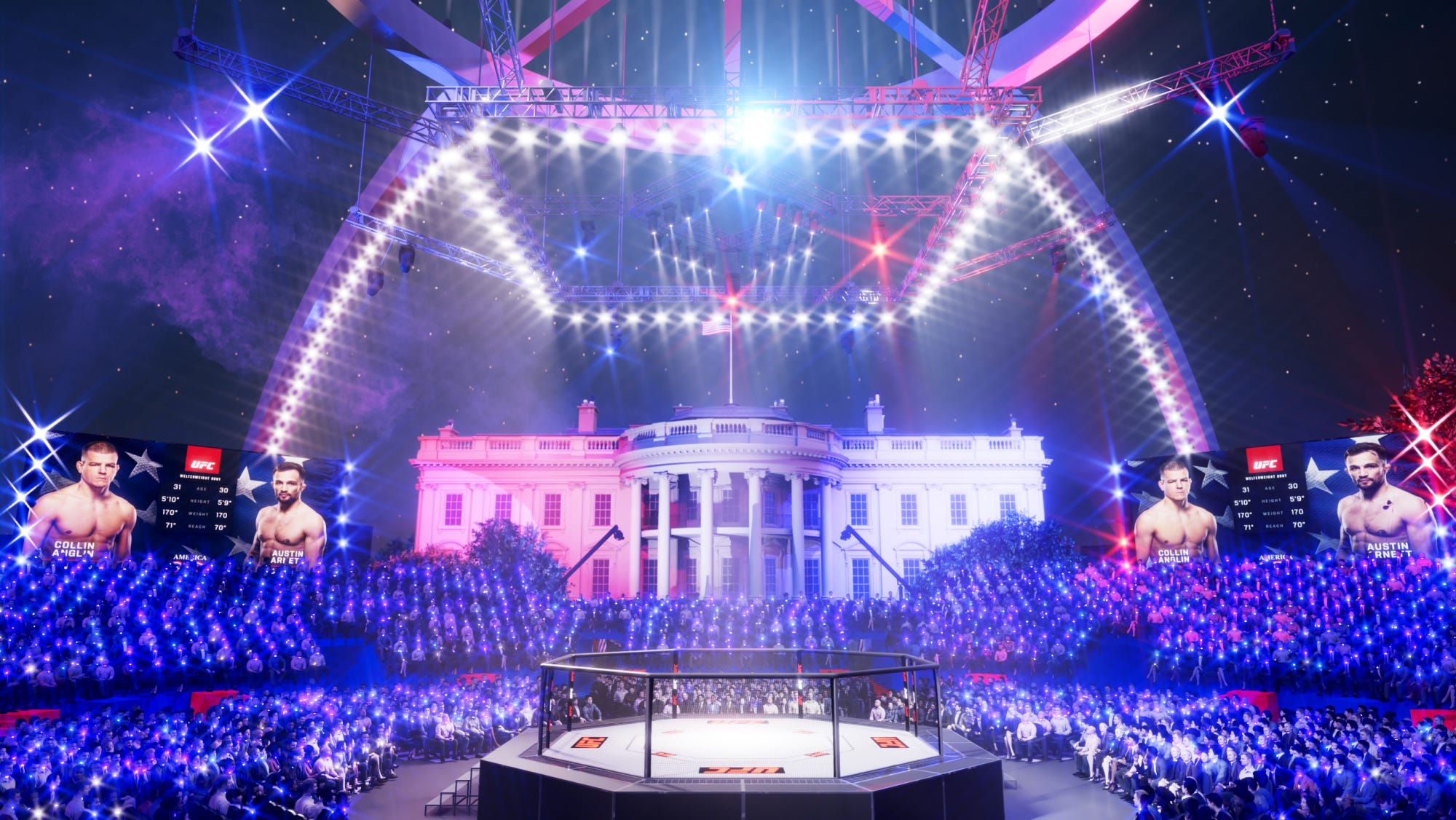
Neil Postman did not live to see this. He died in 2003, two years before YouTube existed and a decade before the smartphone colonized every moment of human attention. But on the evening of June 14, 2026, on the South Lawn of the White House, beneath a structure called “The Claw,” with jet fighters screaming overhead and 4,000 invited guests watching two men attempt to knock each other unconscious, his 1985 prophecy completed itself in real time.
The occasion was UFC Freedom 250. The framing was America’s 250th birthday. And the spectacle — a custom-built octagon where Lincoln once walked, surrounded by giant video screens and patriotic staging, with the sitting president of the United States watching cage-side — was not, as critics rushed to say, a departure from American political culture. It was its logical destination.
Postman’s argument in Amusing Ourselves to Death was unsentimental. He was not worried about censorship but something more insidious: a culture so saturated in entertainment that it loses the cognitive infrastructure required for serious public life. His villain was not politicians. It was television and the epistemology television installs, in which all content, including the gravest, must be made entertaining to exist at all. “We are now a culture,” he wrote, “whose information, ideas, and epistemology are given form by television, which is to say, by entertainment.”
“We are now a culture whose information, ideas, and epistemology are given form by television, which is to say, by entertainment.”
What happens, he asked, when the medium of public discourse is entertainment? You do not get citizens. You get audiences. You do not get deliberation. You get spectacle. You do not get a republic. You get a show.
Ancient Greek’s Agora vs. White House’s Octagon
Postman borrowed from Aldous Huxley the insight that democratic civilization faces two threats, not one. The Orwellian threat, which he refers to as jackboots, censorship, or coercion. This is the one we trained ourselves to recognize and resist. The Huxleyan threat, on the other hand, is the one we never saw coming: that people would come to love their oppression, that the apparatus of control would take the form not of a prison but a pleasure palace. “In 1984,” Postman noted, “people are controlled by inflicting pain. In Brave New World, they are controlled by inflicting pleasure.”
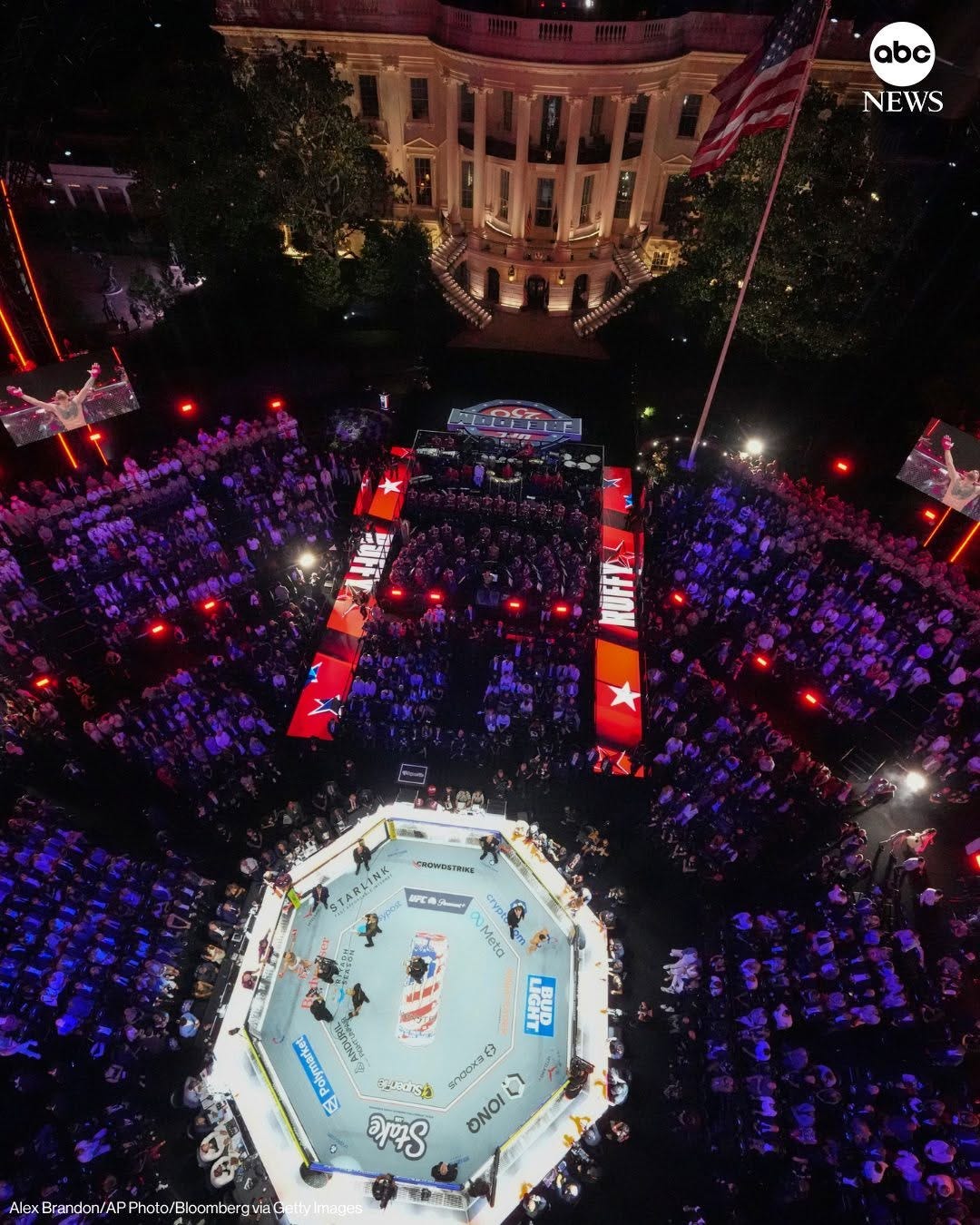
The UFC event at the White House was not coercive. Nobody was forced to watch it. Thousands, if not millions, cheered. The Zac Brown Band played the National Anthem. The Armed Forces Joint Chorus sang. Fighter jets performed a flyover. It was, by all visible measures, a celebration, and that is precisely the point.
Postman’s concern was not that entertainment is bad. His concern was what happens when entertainment becomes the standard by which all public occasions are evaluated. When the question “Is this meaningful?” is replaced by “Is this watchable?” When gravitas is not merely absent but actively suspicious — a sign that something has gone wrong with the production value.
Postman’s Framework
In Amusing Ourselves to Death, Postman argues that every medium of communication has an inherent bias, which privileges certain kinds of content and makes others nearly impossible to sustain. Print privileges coherence, sequence, and sustained argument. Television privileges speed, drama, and emotional impact. I am not sure what to make of the Internet and social media — they are probably worst.
But Postman’s central claim was that when television becomes the dominant medium of public discourse, it doesn’t just change how we communicate but changes what we think is worth communicating at all. Ideas that cannot be made entertaining are not censored. The same could be said about ideas that cannot be made viral in the age of social media. They simply stop being expressed, because no one can hold an audience long enough to receive them.
The question for 2026 is not whether this diagnosis was right. It was right. The question is, at least for me, what does it look like when the presidency itself adopts entertainment as its primary mode of self-presentation?
A symptom is a much bigger problem
It would be satisfying and probably false to locate the problem in one man or one administration. Trump is not the author of the culture that made the UFC 250 possible. He is its most fluent reader. He grasped, earlier than most, what the media theorist Marshall McLuhan had argued decades before Postman: that the medium is the message. In a television culture, the person who understands television wins. In a social media culture, the person who understands social media wins. Trump did not create the appetite for spectacle but inherited it and accelerated it.
The most worrying question is what conditions made such fluency politically viable and even rewarding. And the answer runs through four decades of a media ecosystem that steadily replaced thoughtful deliberation with entertainment, civic literacy with emotional intensity, and policy argument with brand performance. By the time a cage fight on the White House lawn became possible, the cultural groundwork had long been laid.
Postman was indeed describing a structural shift, not a personality flaw. The presidency was always going to become more theatrical as television became more dominant. The only variable was how far the theatricality would travel, and how completely the audience would consent.
The presidency was always going to become more theatrical. The only variable was how far the theatricality would travel and how completely the audience would consent.
What entertainment does to public life
Postman identified three specific harms that result from the entertainment-ification of public discourse. Each is visible in the UFC White House event, and each is worth naming clearly.
First, it collapses context. Entertainment works by stripping away everything except the moment. A cage fight is, by design, complete in itself: two bodies, one outcome, the crowd. It requires no prior knowledge, no sustained attention, no interpretive frame. When this logic migrates into politics, everything becomes self-contained. There is no before and no after, no historical memory and no policy consequence; and sadly just only the event, the reaction, and the clip.
Second, it makes complexity illegible. The conventions of entertainment demand clarity of conflict: hero and villain, winner and loser, applause and silence. Democracy requires something much more different and that is the tolerance of ambiguity, the patience to hold contested claims simultaneously, the recognition that most serious problems resist clean resolution. When entertainment becomes the grammar of public life, ambiguity reads as weakness and nuance reads as confusion. The audience becomes impatient with anything that cannot be resolved before the commercial break.
Third, it produces audiences rather than citizens. Postman drew this distinction carefully. An audience is passive, reactive, and essentially private. It receives. It responds emotionally. It does not deliberate, does not persuade, does not bear collective responsibility for outcomes. A citizenry, by contrast, is constituted by participation in shared self-governance. It argues. It decides. It holds itself accountable across time. Entertainment does not destroy citizenship directly. It simply offers a substitute experience and the feeling of participation without the weight of it.
The 250th celebration and the question of self-understanding
There is a particular poignancy in the timing. The UFC event was framed as a birthday celebration and a marker of what the United States has become, two and a half centuries after its founding. And in that sense, whatever one thinks of the event, the framing is not entirely wrong. The event is a marker. It reflects something real about what this culture has become, what it values, and what kinds of occasions it reaches for when it wishes to commemorate itself.
The founders, for all their strengths and weaknesses, understood that republican self-governance required what they called virtue — a disposition toward the common good that could only be cultivated through education, deliberation, and the exercise of civic responsibility. They disagreed, sometimes bitterly, about what virtue required. But they shared the premise that democracy was demanding work, not entertainment.
John Adams wrote that “democracy never lasts long. It soon wastes, exhausts, and murders itself.” He was not predicting authoritarianism. He was predicting the exhaustion of the civic capacity that democracy requires. A polity that cannot sustain deliberation — that finds it boring, unappealing, or simply less engaging than a cage fight — will not lose its democracy in a single dramatic moment. It will lose it in a long, pleasant drift toward managed spectacle.
A polity that finds deliberation boring will not lose its democracy in a dramatic moment. It will lose it in a long, pleasant drift toward managed spectacle.
The flourishing we are not having
From a flourishing science perspective, there is an important distinction between hedonic well-being (the experience of pleasure, excitement, and positive affect) and eudaimonic well-being (the deeper sense of meaning, growth, relational depth, and contribution to something larger than oneself). Both matter. Neither is sufficient alone.
What the White House UFC event delivers is a powerful hedonic experience. Excitement. Energy. Belonging to a crowd. The visceral pleasure of spectacle. These are real experiences, and they are not nothing. But a civilization organized primarily around hedonic intensity and around the perpetual provision of stimulating content will find its deeper eudaimonic needs slowly unmet. Meaning is not produced by spectacle. It is produced by shared struggle, honest conversation, and the willingness to engage complexity without resolving it prematurely.
This is what Postman feared: not that Americans would stop caring about their country, but that they would express that care in increasingly shallow registers, and mistake the emotional intensity of entertainment for the substance of civic life. The crowd cheering in the octagon is not a republic deliberating. It is an audience enjoying itself. These are not the same thing and confusing them is the specific danger Postman spent his career naming.
What then remains
The question that follows from Postman’s diagnosis is the hardest one: what do we do? He was not optimistic. He saw no clear corrective and no lever to pull that would restore a print-based epistemology to a television-saturated culture. He ended Amusing Ourselves to Death with a note of careful despair, suggesting that awareness might be the best available resource: “that we take seriously the matter of who will master whom.”
Awareness is not nothing. It is, in fact, the precondition for everything else. A culture that can name what is happening to it and can recognize entertainment as entertainment and deliberation as deliberation, and understand that these are different activities that produce different kinds of people will retain a foothold that a culture of pure spectacle does not.
But awareness requires honest institutions, honest media, and citizens who are willing to do something genuinely difficult: to find the unspectacular work of self-governance more compelling than the spectacle offered in its place. Whether that capacity still exists, and in what numbers, is the question the next decades will answer.
On the South Lawn, the fights went on. The crowd cheered. The jets flew over. And a republic, somewhere between its 250th birthday and its reckoning, watched itself on the screen.
For reflection
What would it look like to deliberately cultivate the habits of deliberation (e.g., sitting with ambiguity, engaging with people whose conclusions differ from yours) not as a civic duty, but as a practice of human flourishing?
What have you consented to be entertained by, in the place where you might have been formed?