

They Bombed the Cathedral. The Sky Is Still Open.
A study of religious believers reveals something unexpected about resilience: when the places we hold sacred are taken from us, a great many of us can still find holiness underfoot.
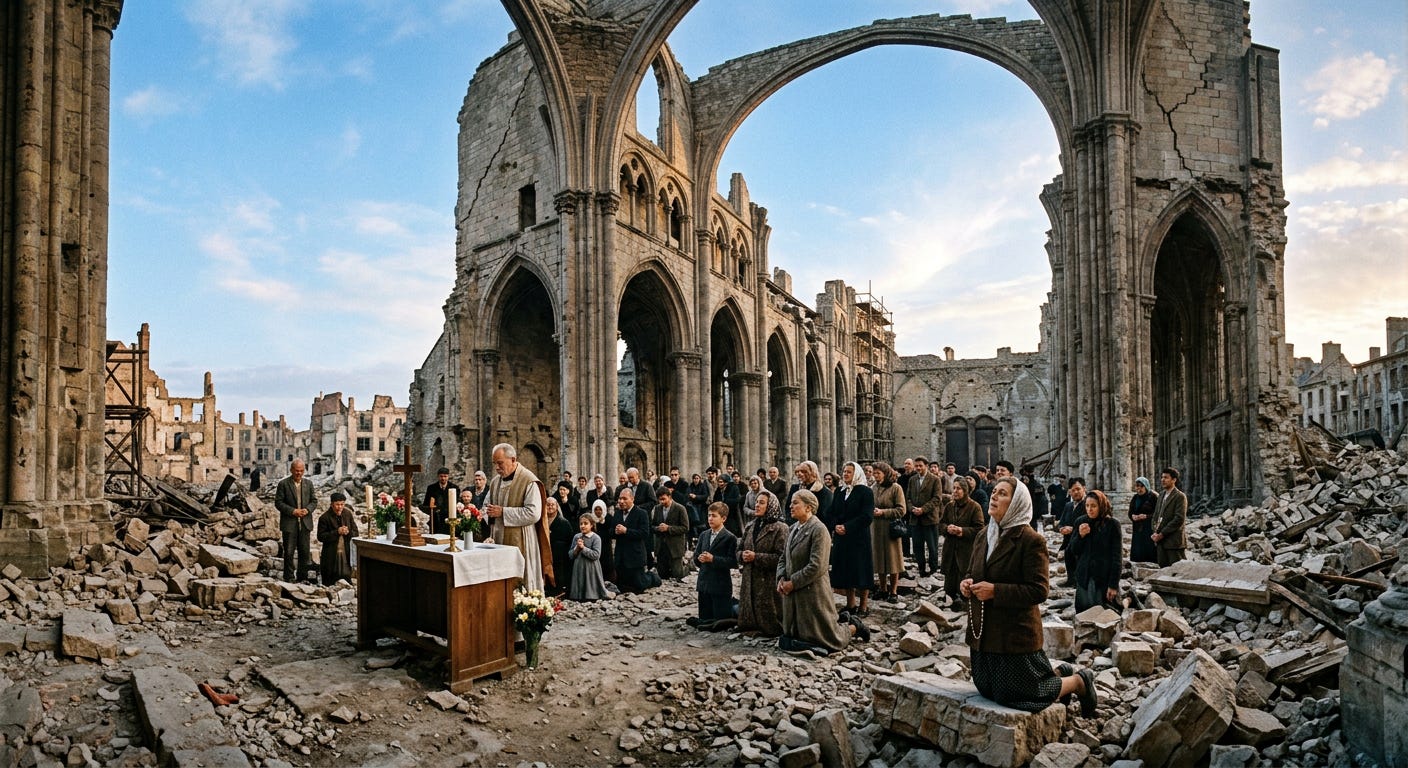
A refugee leaves a war-torn city. The mosque where she prayed is rubble. The streets that oriented her childhood are checkpoints now, or gone. On every conventional measure she has lost her place in the world. And yet she still has the moon that marks her prayer times, and the earth beneath her when she kneels.
That small persistence points to something we tend to miss when we talk about home, loss, and what helps people cope when their surroundings come apart. We usually treat place as scenery, real estate, or logistics. But for a great many people, place is also where they meet the sacred. And when the places we love are taken, what we lose is not only an address. It is a way of being held and loved.
We are living through an age of disappearing places. Rising seas erase coastlines. Wildfires take neighborhoods in an afternoon. Conflict and climate push record numbers of people from the ground they know. The stability of “place” can no longer be assumed, though that stability was always more fragile than we liked to believe. Most responses to this crisis treat land as a resource to be managed, a carbon figure to be measured, or a backdrop where human life plays out. Necessary, all of it. But it skips the dimension that has motivated people to protect the land for as long as there have been people: the sense that some places are holy.
What the research actually found
A few years ago, my team got a small grant to survey more than 800 nationally-representative North American adults from the three Abrahamic traditions, asking each of them to describe a place where they felt spiritually connected. We then sorted those descriptions by their patterns. Four kinds of sacred place emerged: houses of worship, natural settings, private spaces, and unfrequented places held in memory.
The finding that surprised us most concerns nature. Among these religious believers, the people centered on traditions built around temples, churches, and mosques, nearly a third anchored their deepest spiritual connection in forests, mountains, rivers, and parks. When we asked everyone to describe a spiritually significant place, two out of three pointed to large outdoor environments rather than buildings or rooms. The cathedral, for many believers, turns out to be the open sky.
I want to be careful here, because this is one study, of one population, in one part of the world. It does not prove that everyone everywhere senses the sacred the same way in nature. Culture shapes these bonds profoundly. Many Indigenous peoples hold a genealogical tie to one specific river or mountain, a relationship of descent and obligation that cannot simply be transplanted somewhere else green. So I am not claiming a universal human instinct. What I am noting is that even inside the great architectural religions, the pull toward sacred nature is far stronger and more widespread than we assumed.
A different kind of value
The people in this “nature” group were set apart less by their doctrine than by their experience. They reported more peace, more awe, more of that vertigo of standing before something vast. Over half named peace or restoration as the heart of their connection.
This is where I think the research speaks to our larger predicament. When you experience awe in a forest, the forest stops being an object you manage and becomes something closer to a presence you answer to. Pollute a river you consider holy and you have not committed a management error; you have committed a desecration. Standard sustainability talk runs on a logic of utility: save the earth because it sustains us. True enough, but it keeps humans in the driver’s seat and nature in the trunk. Sensing the sacred in a place overturns that arrangement. The place is no longer an “it.” It becomes, in the old language, a “Thou.”
I call this shift radical relationality, and it is where ordinary flourishing becomes co-flourishing. Our well-being and the health of the living world stop being separate goods we trade against each other. You cannot calm a frayed nervous system in a clear-cut forest. You cannot feel the grandeur of creation in a poisoned river. The flourishing of the person and the flourishing of the land turn out to be the same project, approached from two directions.
Why this matters when the ground gives way
Here is the part that returns us to the refugee and her moon. A spiritual life tethered to one building is fragile. During the pandemic, millions felt a genuine spiritual crisis when the doors of their churches and synagogues and mosques were locked. A home lost to fire takes its sanctuary with it. But a connection rooted in the natural world carries a strange durability.
I want to be honest about the limits of this, because it is the claim most worth questioning. What travels is not the place itself; a concrete lot behind a gas station is no substitute for the forest of your childhood, and losing a specific sacred place is real grief that no theory should paper over. What can travel is the capacity to recognize the sacred in the natural world wherever enough of it remains. The displaced farmer who arrives somewhere unfamiliar still has the semblance of the tides, the quiet of a local park, the turning of the seasons. Through these, slowly, a new landscape can be received as sacred too. The park becomes a kind of Bethel, a house of God in a foreign country. This does not erase the loss. It widens the self to include a new home alongside the grief for the old one.
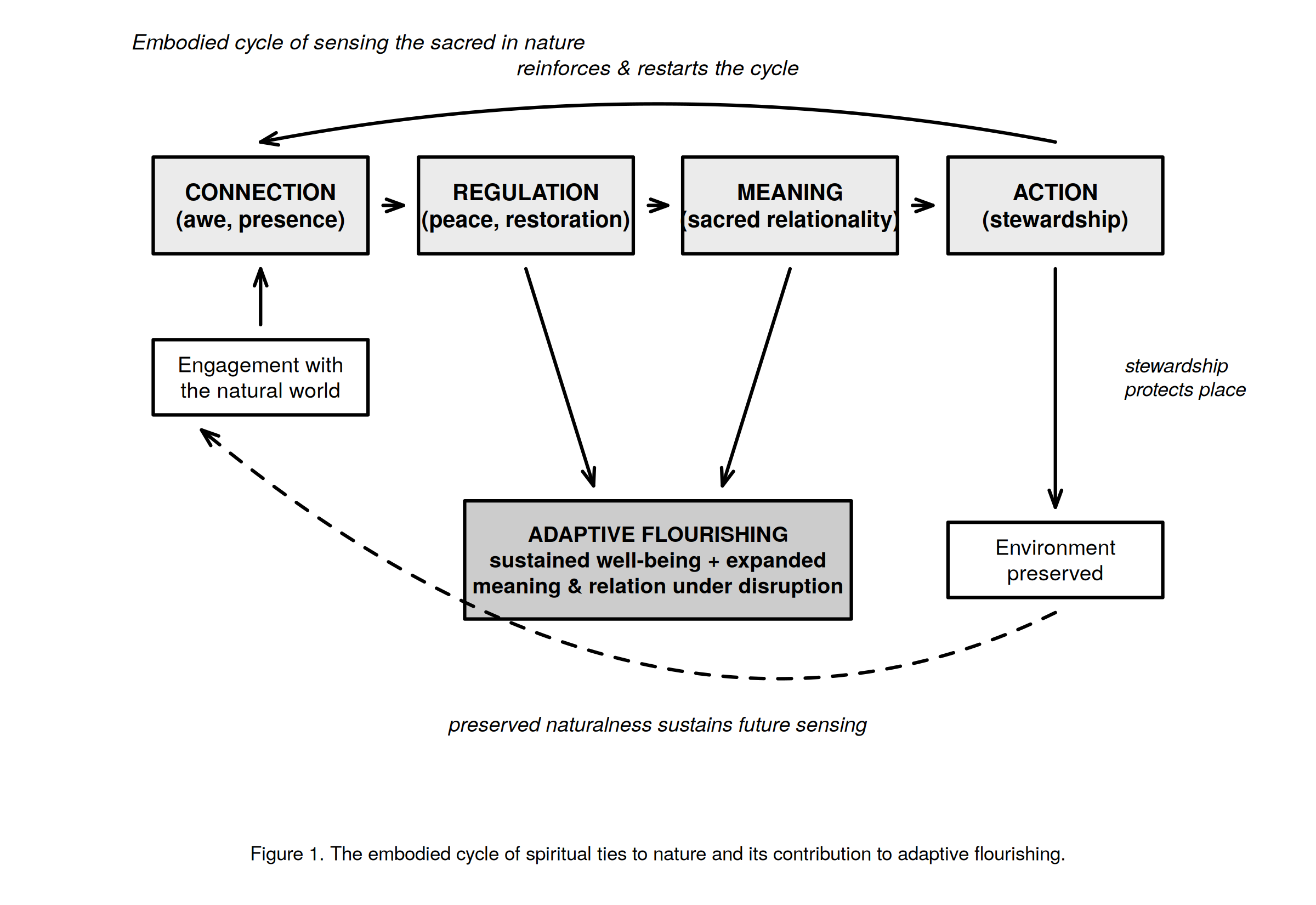
The embodied cycle of sensing the sacred in nature. Engagement with the living world initiates connection (awe), supports regulation (peace and restoration), deepens meaning (sacred relationality), and issues in action (stewardship). Regulation and meaning feed adaptive flourishing, while action protects the environment and sustains the cycle.
There is a parallel comfort in time. Trauma traps people in a frantic present where the past is severed and the future is terrifying. The natural world runs on a slower clock. Winter turns to spring. Burned ground sends up green shoots. To align yourself with those cycles, even a little, is to be reminded that endurance is the oldest pattern there is.
What we might do with this
If a significant share of people anchor their spiritual lives in the living world, then the degradation of that world is not only an ecological emergency. It is a threat to spiritual and psychological continuity, a casualty hidden in plain sight.
That suggests some concrete turns. Planners and governments might treat sacred natural sites as genuine infrastructure for well-being rather than as scenery or biodiversity statistics, and measure “spiritual displacement” alongside the economic kind when a beloved woodland is cleared. Cities might leave wild patches that allow for awe instead of only manicured lawns, and protect quiet enough for nature to do its restorative work. Therapists working with eco-anxiety or displacement might help clients build a relationship with an accessible patch of nature, inviting the living world to help steady them.
None of this asks anyone to abandon their tradition or their God, but the opposite. It takes seriously that for a great many people, the encounter with the sacred has always happened partly out of doors, in the company of trees and water and sky, and that protecting those places is therefore not a secular chore but something closer to an act of devotion. Recover the self, restore the world. It increasingly looks like the same act.
This article is an exercept from my chapter contribute “Sensing the Sacred in Nature” for Daniel Williams and Christopher Raymond’s edited volume — in press — “Senses of place and sustainability: Emerging perspectives on place, practice and ethics in environmental governance” by Cambridge University Press
Further readings of my work on place and spirituality
Counted, V., Meagher, B. R., & Cowden, R. G. (2026). Spiritually significant places as adaptive psycho-spatial resources: Mattering struggles, spiritual ties to place, and mental well-being in US adults. Archive for the Psychology of Religion https://doi.org/10.1177/00846724251408338
Counted, V. (in press). Sensing the Sacred in Place: Embodied Mechanisms of Spiritual Ties to Place. B. Jorgensen (ed.), Handbook of Sense of Place. Eldger
Meagher, B. R., Cowden, R. G., Goldammer, L., Piazza, M., Aten, J., & Counted, V. (2025). The Varieties of Spiritual Ties to Place: A Latent Class Analysis. Psychology of Religion and Spirituality. Advance online publication. https://doi.org/10.1037/rel0000560
Counted, V., Lomas, T., Cowden, R., Lee, M. T., Allen, K.-A., Basu, J., Laidler, D., Routledge, C., Seaman, D., & VanderWeele, T. J. (2025). Love of place: Conceptual framework and template for measuring the contributory and unitive affection towards a place. International Journal of Intercultural Relations 107, 102203. https://doi.org/10.1016/j.ijintrel.2025.102203
Counted, V., Meagher, B., & Cowden, R. (2024). The Nature of Spiritual Ties to Place: A Conceptual Overview and Research Agenda. Ecopsychology, 16(1), 60-70. https://doi.org/10.1089/eco.2022.0078
Counted, V. & Newheiser, D. (2023). How Place Shapes the Aspirations of Hope: The Allegory of the Privileged and the Underprivileged. The Journal of Positive Psychology. Online publication ahead of print. https://doi.org/10.1080/17439760.2023.2257654
Counted, V., Ramkissoon, H., Captari, L. E., & Cowden, R. G. (Eds.). (2023). Place, Spirituality, and Well-Being: A Global and Multidisciplinary Approach (Religion, Spirituality and Health: A Social Scientific Approach Vol. 7). Springer Nature. https://doi.org/10.1007/978-3-031-39582-6
Counted, V, Neff, M., Captari, L., Cowden, R. (2021). Transcending place attachment disruptions during a public health crisis: Spiritual struggles, resilience, and transformation. Journal of Psychology and Christianity 39(4), 276-286.
Counted, V. (2019). The Role of Spirituality in Promoting Sense of Place among Foreigners of African Background in the Netherlands. Ecopsychology 11(2), 101–109. http://doi.org/10.1089/eco.2018.0070
Counted, V. & Zock, H.T. (2019). Place Spirituality: an attachment perspective. Archive for the Psychology of Religion 41(1), 12–25. https://doi.org/10.1177/0084672419833448
Counted, V. & Watts, F. A Space of Transition and Transaction: A rejoinder to selected commentaries on place spirituality. Archive for the Psychology of Religion 41(1), 43–52. https://doi.org/10.1177/0084672419832673
Counted, V. & Watts, F. (2019). The Psychology of Religion and Place: Emerging Perspectives. Springer/Palgrave MacMillan. https://doi.org/10.1007/978-3-030-28848-8_1
Counted, V. (2018). The Circle of Place Spirituality: Toward a motivational systems theory in the psychology of religion. Research in the Social Scientific Study of Religion 29, 149-178. http://dx.doi.org/10.1163/9789004382640_009
Counted, V. & Watts, F. (2017). Place Attachment in the Bible: The role of attachment to sacred places in religious life. Journal of Psychology and Theology 45(3), 218-232. https://doi.org/10.1177/009164711704500305