

Trapped in Place, Starved of Hope
You cannot think your way out of a broken geography.
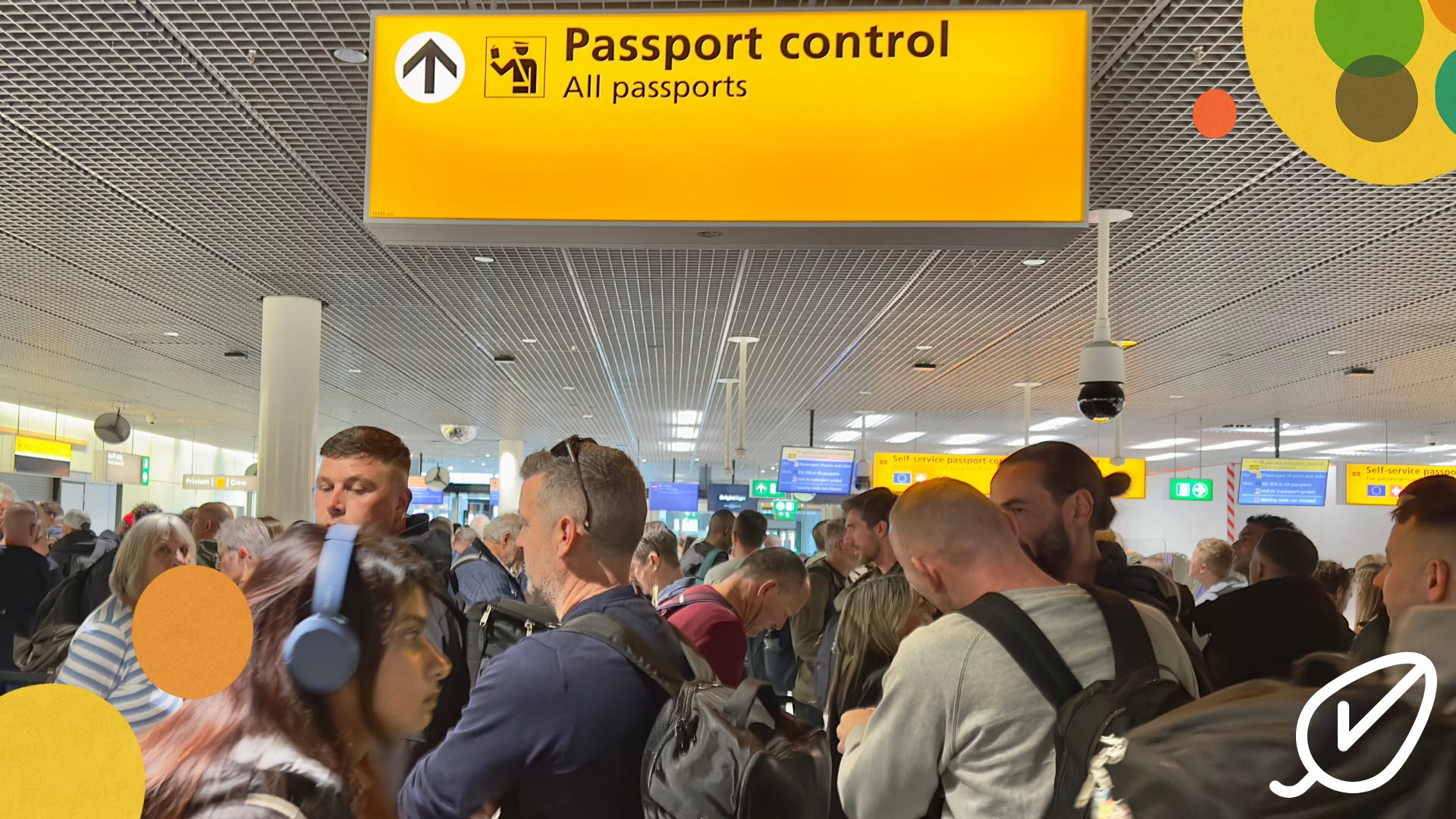
Imagine yourself standing in the snaking queue of an international airport’s immigration line, your passport clutched just a bit too tightly in a hand that is clammy from a ten-hour flight. Around you is a low-frequency hum: the murmur of a dozen languages, the rhythmic shuffle of weary travelers, and the distant, mechanical clack-clack of stamps hitting paper. Everyone in this cavernous hall is technically in the same physical space---a climate-controlled terminal with high ceilings and fluorescent lights---and yet, as you inch forward, you realize you are occupying entirely different realities.
The line eventually bifurcates, subtly yet decisively, offering a stark, public tableau of our global divides. On one side, the queue moves with a practiced, almost breezy efficiency. These are the holders of “privileged” passports, for whom the border is less a barrier and more a minor administrative formality. They check their watches with an air of mild inconvenience, already envisioning the taxi ride home or the business meeting ahead. Their future is clear, accessible, and imminent. Then there is the other line. This one is longer, denser, and moving at a painstakingly slow pace. It is crowded with individuals from less affluent nations, their faces etched with a mix of profound fatigue and palpable tension. In this line, the “where” of one’s birth becomes a heavy, visible weight. For these travelers, the future is not a guarantee; it is a precarious hope that must be negotiated, defended, and granted by a stranger behind a glass booth.
In that moment of bifurcation, we witness the death of a modern myth: the idea that hope is a self-contained, internal resource. For decades, the Western psychological establishment has sold us a version of hope that looks like a psychological “bootstrap”---a cognitive muscle known as “agency” and “pathways.” We have been told that if you can just envision a goal and find the will to reach it, you are hopeful. But as I watched the faces in the slow-moving line, I realized how cruel and insufficient that perspective is. How can we talk about hope as a purely internal “will” when the very “ways” to achieve that hope are physically and legally barred by the architecture of the space? It was there, amidst the shuffle of weary feet, that I realized we are in the midst of a “place-blind” crisis. We have spent a century trying to fix the human mind while ignoring the maps that break it.
This realization has led me to propose what I call a “Spatial Turn” in the science of the human spirit. We need to move beyond the individualistic cage of traditional psychology and recognize a new, urgent reality: Spatial Hope. This theory posits that hope is not a private feeling we carry within us; it is a relational process that rises and falls with the strength of our tethers to the places we inhabit. Just as a child gains the courage to explore the world only when they have a “secure base” in a caregiver, we gain the capacity to envision a future only when we are anchored in a “secure base” provided by our environment. Hope is an ecosystem, not an essence. It is the result of a profound “fit” between the individual’s identity and the geography of their daily life.
To prove this, I turned to my findings from the Global Flourishing Study (GFS). In one of my papers, Where Hope Thrives, I talk about this phenomenon. The GFS is a landmark study of over 200,000 individuals across 22 countries. In almost all the GFS papers, our team discovered a “Paradox of Prosperity” that shatters our conventional wisdom. If hope were a byproduct of wealth, the maps of aspiration would be colored in the shades of the G7. Instead, we found that hope thrives in the “thick” spaces of Indonesia and Mexico, while it falters in the high-pressure individualistic urban corridors of Japan and Sweden. Why? Because in Indonesia, hope is not a solo act. It is anchored in the social and sacred infrastructure of the village and the mosque---essentially, spaces designed for interdependence. In Japan, the environment of extreme work pressure and social isolation creates a “spatial hopelessness” that no amount of individual “grit” can overcome.
The implications of this shift are seismic. Because if hope is a spatial commodity, then our urban planners, our politicians, our architects, and our policymakers are not only building cities and nations; they are the unacknowledged curators of the human spirit. When we design a neighborhood that segregates the poor, or when we divest a rural town of its infrastructure, we are systematically stripping away the anchors that allow people to hope. Conversely, when we build “Spatial Pathways”---like the Metrocable in Medellín that connects the periphery to the center, or the inclusive public squares of Berlin---we are performing an act of psychological restoration. We are giving the marginalized a “place to stand” so they can finally afford to look at the horizon.
The same curator’s responsibility extends to the legal architecture of our borders. When migration policies prioritize human dignity over bureaucratic suspicion, they function as a new ‘secure base’ for the uprooted. A policy that offers a clear path to belonging or protects the right to labor is not merely managing a population but repairing a shattered capacity to look forward. When nations create a ‘dignity-first’ migration framework, they ensure that the act of crossing a border is not the end of a person’s story, but the beginning of a new journey---one where they are no longer just a traveler in a slow line, but a neighbor with a future.
We are currently witnessing a global attachment crisis. As millions are uprooted by climate change, war, and economic stagnation, they are being thrust into “non-places”---sterile refugee camps and sprawling slums that offer no narrative coherence. In these spaces, the individualistic bootstrap myth fails utterly. You cannot ask a person to “reframe their mindset” when the place they inhibit is a closing fist. We must recognize that the right to hope is inextricably tied to the right to place. We need to architect a world that functions as a “secure base” for everyone, regardless of the passport they hold.
This is the challenge of the 21st century. We must stop treating the human mind as a sterilized vessel and start seeing it as a plant that requires specific soil to bloom. I am currently writing a book to introduce the Spatial Turn in hope theory. My sincere hope is that this work will help support the global effort to dissolve the bifurcated lines of the airport terminal and create a shared global geography of possibility. We must realize, once and for all, that the human spirit is never truly alone; it is always, for better or worse, somewhere ---trapped in place. And until that “somewhere” is designed for flourishing, our hope will remain a hostage of our maps.