

Wellbeing, Thriving, Flourishing: Three Words We Keep Using as if They Mean the Same Thing
On wellbeing, flourishing, and thriving, and why mixing them up changes how we research, counsel, and pray for people.

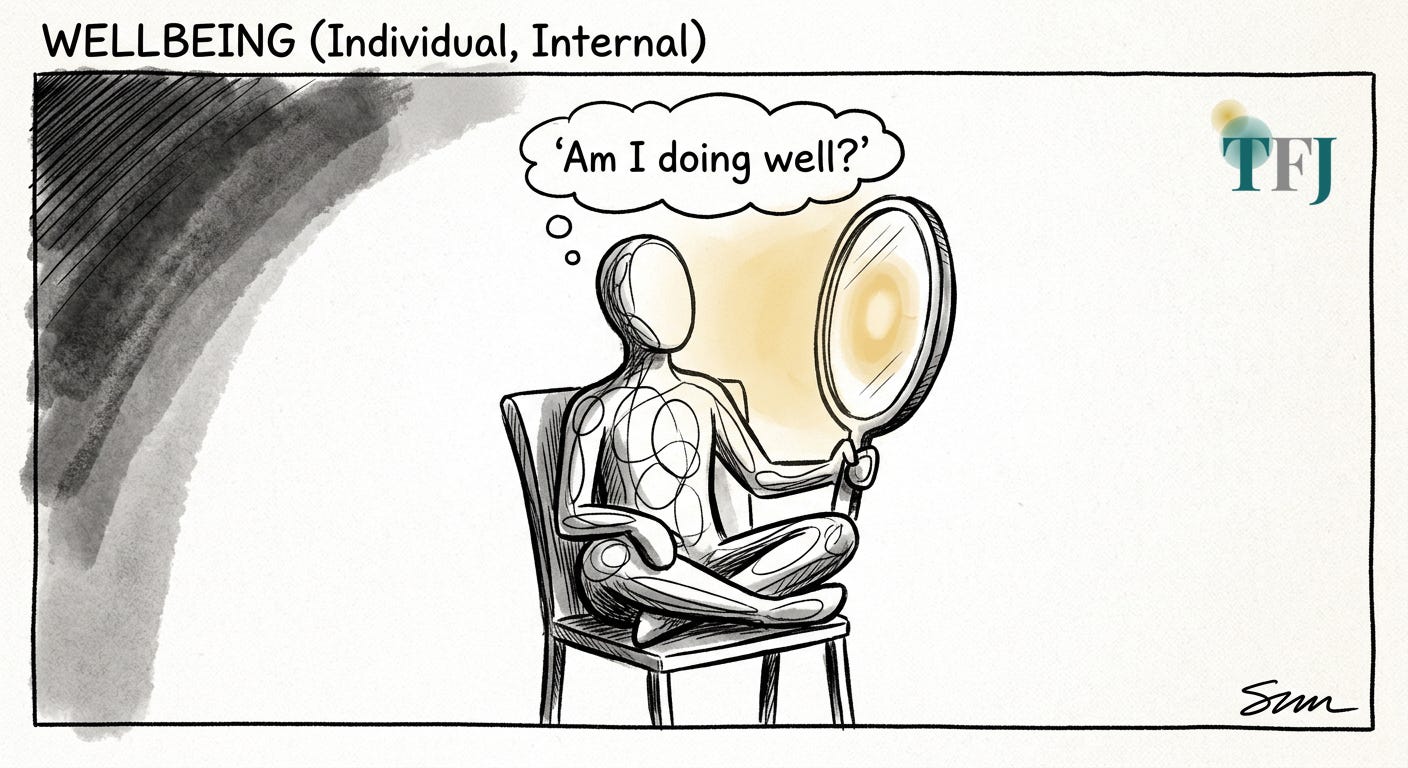
A friend of mine treats the word ‘thriving’ the way most people treat the word ‘fine.’ It comes up every time we connect, unplanned, almost a running joke between us by now. He has a point. Three words show up everywhere in the flourishing literature, in sermons, in HR surveys, in op-eds about Gen Z: wellbeing, flourishing, thriving. Most people use them as synonyms, three warm terms for the same general idea of a life going well. Actually, they are not interchangeable. Each word answers a different question, pitched at a different level, about a different relationship between a person and the world they are living in.
As I think about the difference between the three words, here is the distinction I keep circling back to, and the one I want to lay out properly in this piece. Wellbeing is the individual doing well. Flourishing is the individual doing well in context. Thriving is the individual navigating the structures and systems within that context well. Three cameras, pointed at the same person, set to three different focal lengths.
Wellbeing: the person, examined from the inside
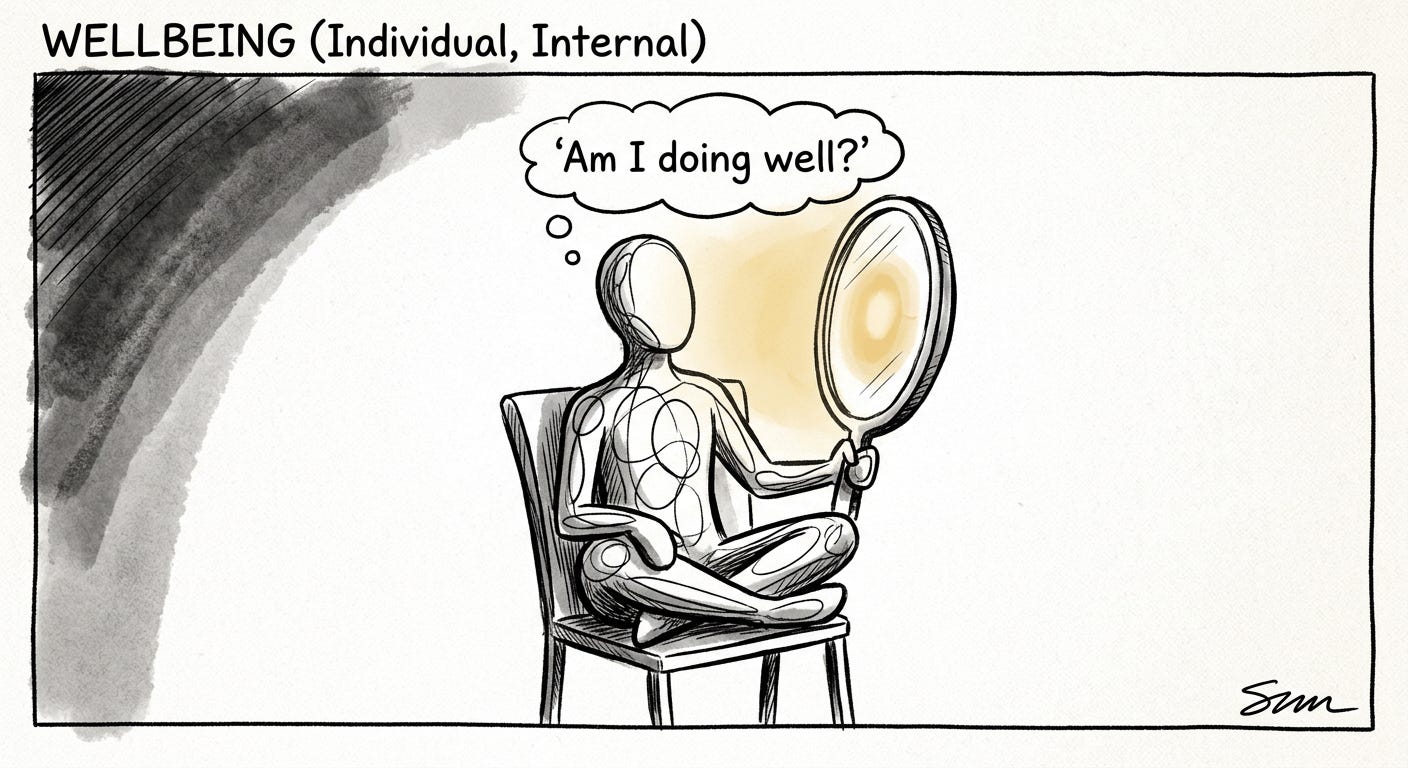
Wellbeing is the oldest and narrowest of the three terms, and the psychology behind it has stayed close to that scope on purpose. Ed Diener’s subjective wellbeing tradition asks how a person evaluates their own life: how satisfied they report being, how much positive affect outweighs negative affect across their days. Carol Ryff’s psychological wellbeing model widens the lens slightly but keeps the camera pointed at the same target, naming six internal capacities: autonomy, environmental mastery, personal growth, positive relations with others, purpose in life, and self-acceptance.
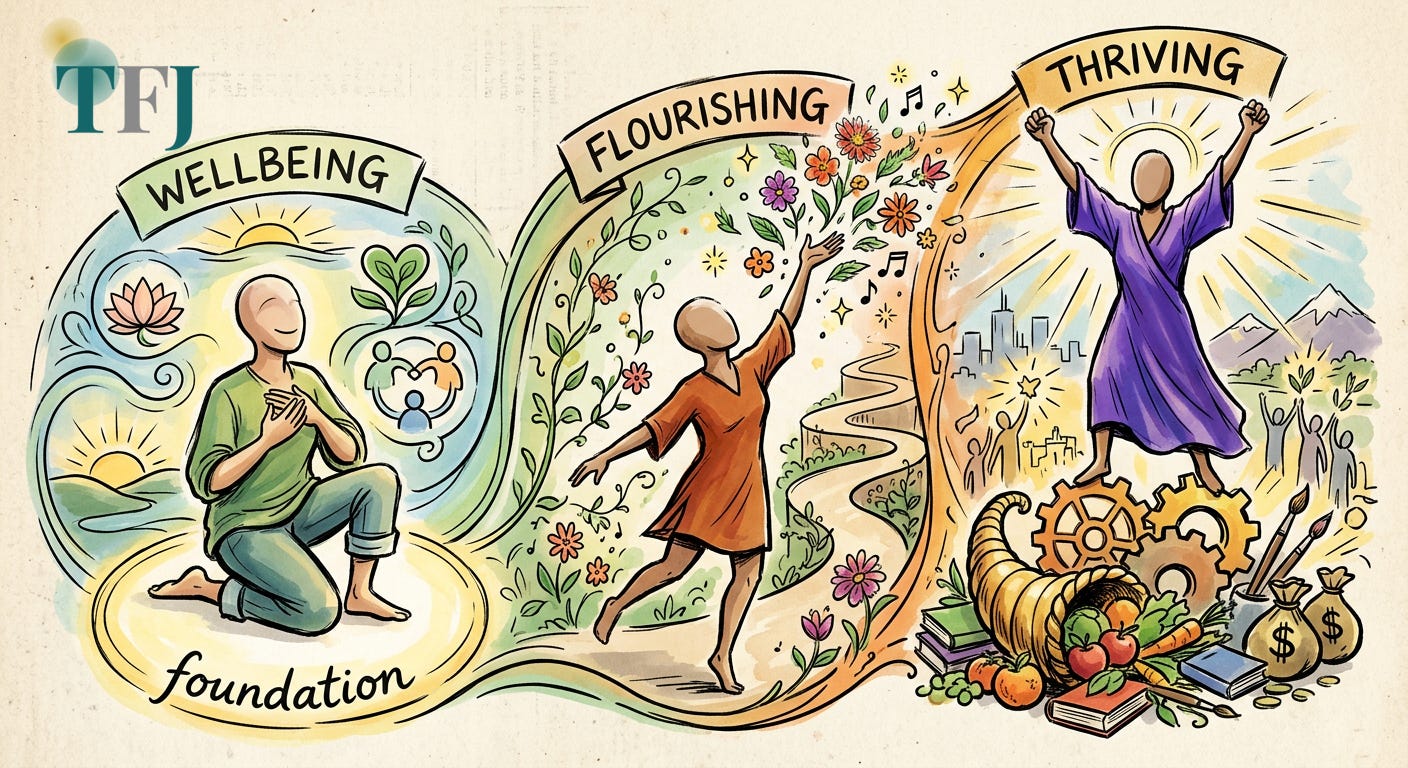
Notice what both traditions have in common. The unit of analysis is the person’s internal state, measured by the person’s own report of it. I see the gap this creates constantly in attachment work: a person can have a well-regulated nervous system and report high wellbeing by every internal measure, and still be attached to people, places, or an image of God that is not actually safe. Wellbeing can rise or fall somewhat independently of what is actually happening around someone. A person can hold steady wellbeing inside a genuinely hard season, which is one reason resilience research exists at all. A person can also report low wellbeing while sitting on every external resource a life could ask for. Wellbeing is asking one question, and it is an honest, important question: how are you doing, in yourself?
Key definition
Psychological wellbeing (Ryff): a six-dimension model of internal functioning, measured by self-report and largely independent of the person’s external circumstances.
Flourishing: the person, examined within a context
Flourishing keeps wellbeing’s question, is this life good, but changes where that question gets checked. It asks whether all the major aspects of a person’s life are good in relation to the context that person is actually standing inside, not in some abstract, context-free sense. Tyler VanderWeele’s working definition, the one the Global Flourishing Study runs on, names the aspects that question has to cover: happiness and life satisfaction, physical and mental health, meaning and purpose, character and virtue, close social relationships, and financial and material stability. None of those can be evaluated without reference to the context surrounding them. A relationship is only as close as the other person makes it. Financial stability is only as real as the economy holding it up. Meaning is usually supplied by a community before it is ever generated alone.
This is the real difference between wellbeing and flourishing, and it is more than a vocabulary upgrade. Wellbeing is checked against the person. Flourishing is checked against the person in their context, so context stops being scenery and becomes part of the measurement itself. It is the difference between asking how someone feels and asking whether the actual shape of their life, examined against the context they are living inside, is in fact good. My own four-stage framework leans on this distinction directly. The outcomes I track, psychological, health, existential, moral, relational, and structural, are an attempt to specify what “good in relation to context” actually has to cover, once context stops being a vague gesture and gets named domain by domain.
Key idea
Flourishing does not ask whether you feel good. It asks whether your life, in relation to the context you are standing in, is in fact good.
Thriving: the person, examined in motion
This is where some of my colleagues both in the United States (see Pam King’s Thrive Center at Fuller) and Australia (check out Lindsey Oades’s thriveability theory) have done the most work. Whenever we connect, the conversation drifts on its own around the difference between the three keywords. For example, both Pam and Lindsey’s work sits in a relational developmental systems tradition, and the way they talk about thriving has stayed with me: thriving is the fit between a developing person and the structures around them, family, school, congregation, economy, culture, and how well that person converts the resources, opportunities, and demands of those structures into forward movement toward purpose. Thriving is not a state a person occupies. It is, essentially—for this reason—a process a person is conducting.
Check out some of our conversations on their work below.
That single move, from state to process, is what separates thriving from flourishing rather than simply restating it. Flourishing can describe a life with good relationships, stable finances, and real meaning, all true at once, and that life can still feel stuck if the person inside it has not learned to work the structures that surround them: the institution that promotes people a certain way, the family system that resists change, the church or community culture with its own unwritten rules. A person can flourish in the VanderWeele sense and still not be thriving in the deeper, developmental-systems sense, simply resourced and parked. The reverse is just as real. A teenager navigating an under-resourced school, a young adult moving through an unstable immigration system, a new believer working out belonging inside a congregation or community that does not yet know what to do with them, can be thriving, actively and skillfully engaging the systems around them, well before their broader context would qualify as flourishing.
Research Note
Thriving (relational developmental systems perspective): the dynamic fit between a developing person and the ecological assets and structural demands of their environment, oriented toward purpose and generativity. Not a fixed trait. Not a static state. A process measured in engagement, not position.
What changes when you use the right word
The distinction proves its worth the moment you try to help someone. If wellbeing is the target, the work is internal, the kind of regulation and meaning-making I built my RAIT model around: Regulate, Relate, Rebuild, Respond. If flourishing is the target, the work is relational and structural: repair the relationships, stabilize the finances, restore the sense of purpose, because no amount of internal reframing substitutes for an actually good context. If thriving is the target, the work is neither of those things alone. It is capacity-building for engagement: helping a person read the systems around them, find the actual levers, and learn to move through structures rather than simply endure them.
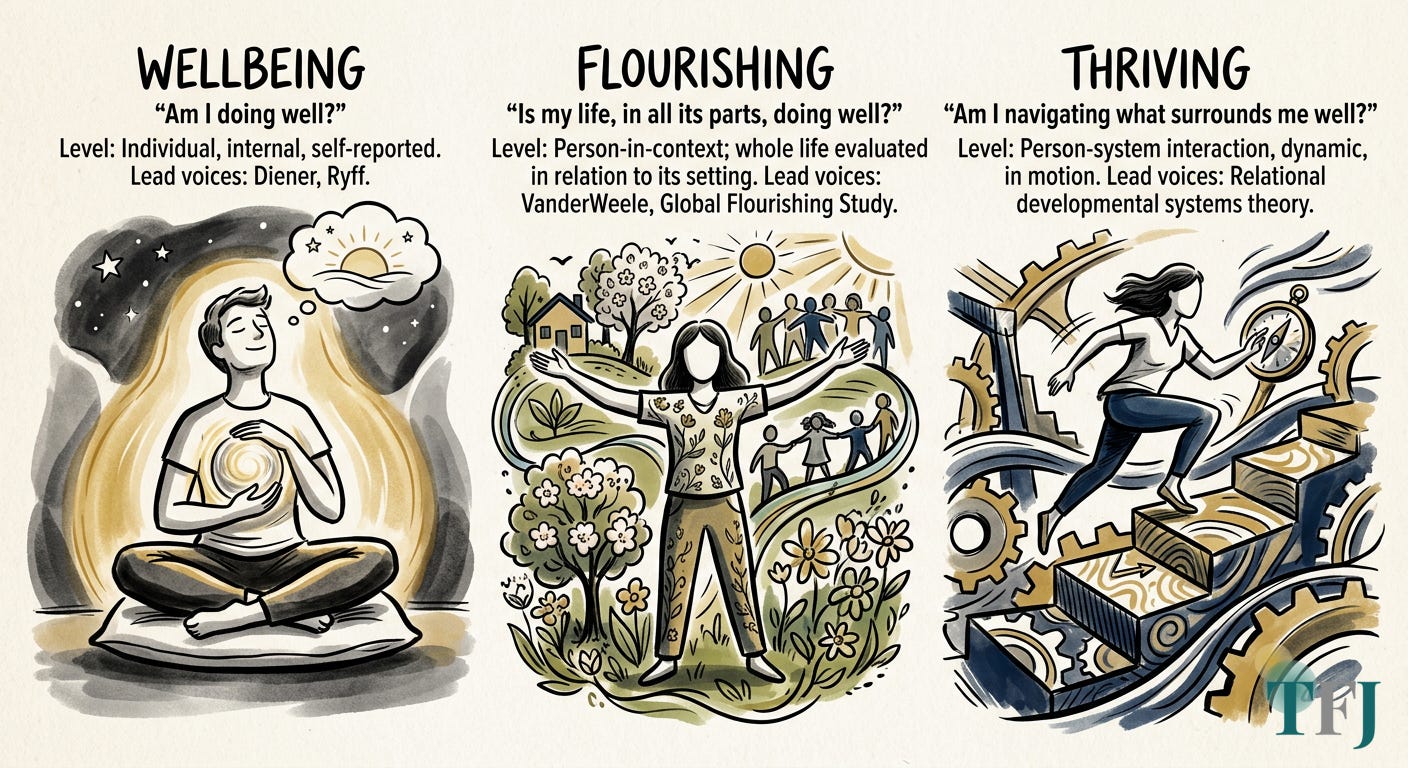
Wellbeing
“Am I doing well?”
Level: Individual, internal, self-reported.
Lead voices: Diener, Ryff.
Flourishing
“Is my life, in all its parts, doing well?”
Level: Person-in-context; the whole life evaluated in relation to its setting.
Lead voices: VanderWeele, the Global Flourishing Study.
Thriving
“Am I navigating what surrounds me well?”
Level: Person-system interaction, dynamic, in motion.
Lead voices: Relational developmental systems theory.

My colleagues and I keep landing on the same closing thought from different directions, even though neither of us planned to. The words are not competing for the same territory, so the goal is not to pick a winner. The goal is to ask, every time someone says they are doing fine, or flourishing, or thriving, which one they actually mean, and whether the rest of us, researchers, pastors, clinicians, friends, are listening closely enough to tell the difference.