

Why Flourishing Feels Elusive
You want to flourish, but what if the usual measures of happiness miss the real story?
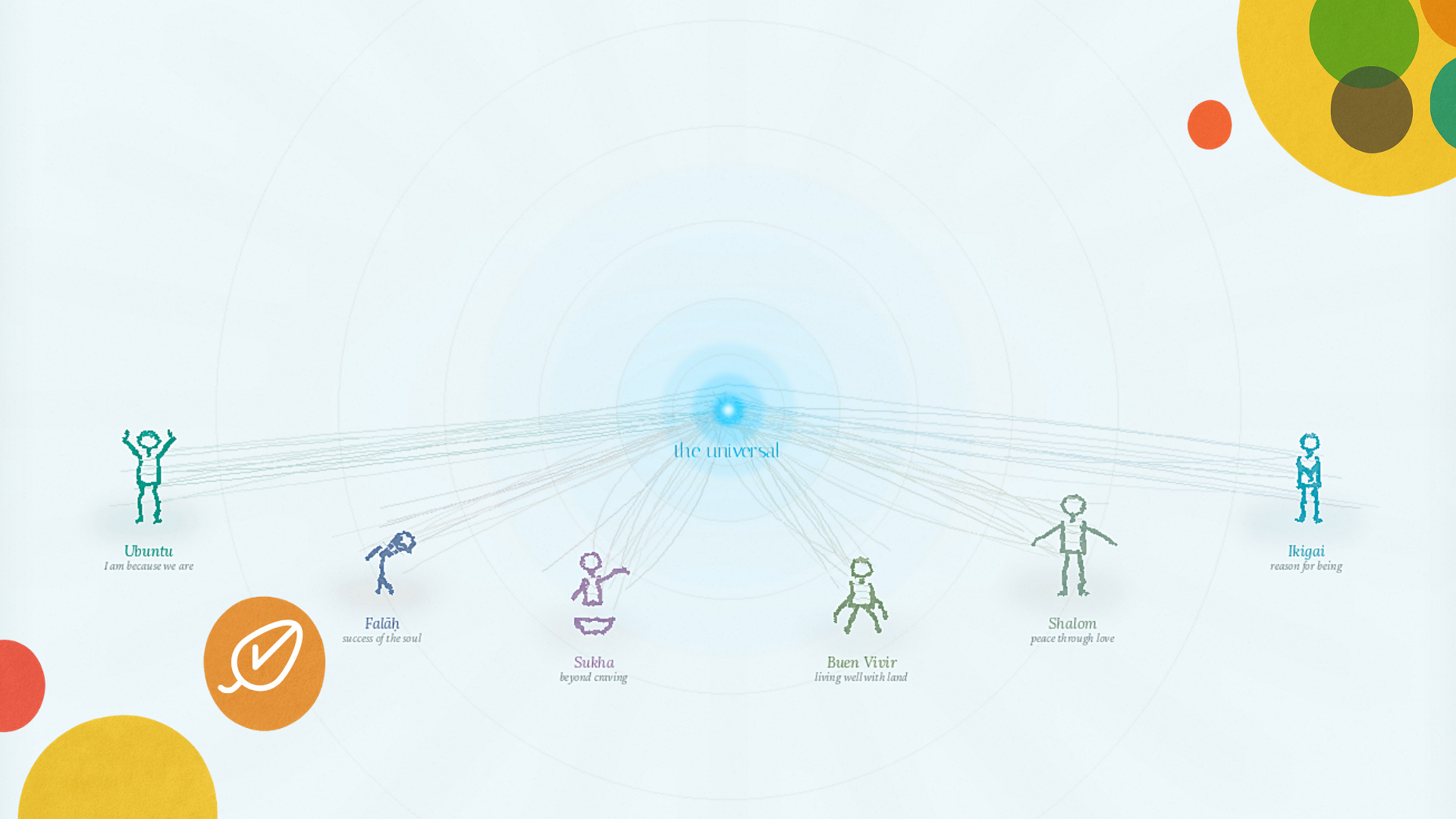
Not long ago, I joined a Zoom call with an interest group meeting at a virtual colloquium, listening to a scholar attempt to explain the complexity of well-being. He spoke in the clean sterile language of modern psychology: non-dualistic sense of happiness, relational harmony, the interconnectedness of the cosmos. To the untrained ear, it sounded like a breakthrough. But as I listened, I realized he was describing something ancient and raw using the bloodless vocabulary of a lab report. He was trying to translate the deep resonant longings of a thousand different cultures into a single, standardized dialect of “well-being.”
This is the central tension in the modern science of flourishing. We have treated “the good life” like a standardized blood type—something universal, biological, and easily measured. But after months of analyzing data from the Global Flourishing Study (GFS) and working within the Harvard Human Flourishing Program, I have come to a startling realization: In our rush to build a universal metric for happiness, we are inadvertently colonizing the human experience.
The Skeleton: The Universal Baseline
In the social sciences, we rely on what is called an etic perspective—an outsider’s yardstick. Drawing from longitudinal data across forty countries, Harvard’s Tyler VanderWeele framework identifies six domains that consistently correlate with a life going well. These are ideals of a good life and the structural pillars that seem to support human life regardless of culture; they are ends in themselves. I provide a summary below of how I understand each of the domains:
Happiness & Life Satisfaction
Mental & Physical Health
Meaning & Purpose
Character & Virtue
Close Social Relationships
Financial & Material Stability
These six domains are the “skeleton” of flourishing. They are measurable, comparable, and empirically rigorous. But a skeleton is not a person. It has no warmth; it has no history; it has no name. In our obsession with the skeleton, we have forgotten that culture is the flesh. We can confirm that “meaning” matters, but the survey data cannot tell us what that meaning is actually made of. That is where culture—and the “emic” perspective—steps in.
We are currently trying to solve a global loneliness epidemic using a Western definition of “connection” that doesn’t work for half the world’s population.
The Flesh: Divergent Ideals
When you move from the universal framework to the lived reality of a particular community, the domains are inverted. The “Standardized Happiness” we measure in a Manhattan high-rise is an entirely different species of emotion than the well-being found in a Senegalese village or an Andean mountain community.
Ubuntu: “I am Because We Are”
In the West, we often view social relationships as a “resource” we tap into to boost our personal well-being. But in the African tradition of Ubuntu, this logic is reversed. Personhood is not something you possess; it is something you achieve through others. Flourishing does not happen inside the individual; it exists in the relational space between us. To measure an African’s well-being by their individual “life satisfaction” is like trying to measure the volume of a radio by looking at a single wire.
Ikigai: Purpose as Harmony
While Western purpose is often tied to individual achievement and “making a mark,” East Asian traditions influenced by Confucianism frame purpose through relational harmony and moral cultivation. The Japanese concept of Ikigai—the reason for waking up—locates meaning at the intersection of passion, social usefulness, and practiced craft. In a place like Japan, happiness is not a goal pursued directly but the byproduct of living well within a social order. Perhaps the real issue with the lower scores in the Global Flourishing Study is not simply that people in Japan flourish less. The issue may lie in how flourishing gets measured. Many flourishing indicators assume that well-being appears as strong self-reported happiness, personal satisfaction, or explicit expressions of meaning. Japanese cultural norms often encourage restraint in such expressions. Modesty, emotional moderation, and sensitivity to group harmony shape how people respond to questions about their own happiness. A person who reports moderate satisfaction may still experience a deep sense of belonging and moral purpose.
Shalom: Wholeness through communion
In the Christian tradition, the six etic domains discussed earlier map onto a different ultimate logic. “Meaning” is not defined by whether activities feel worthwhile. A sense of meaning in Christian thology is defined by alignment with God’s purposes. “Relationships” are not valued primarily because they produce satisfaction; they are a moral obligation rooted in the command to love one’s neighbor. However, this outward expression of God’s love in the world, as one “sent” by a missionary God, is not possible outside right relationship with God. Flourishing, in this frame, is not the self’s highest achievement but a life oriented toward God — one in which even suffering can coexist with a form of thriving social science surveys may not detect.
Falāḥ: Success Beyond the Secular
The Islamic concept of Falāḥ spans both this world and the hereafter. Within this framework, “financial stability” and “health” are not ends; they are instruments of Tazkiyah—the purification of the soul. A person living in material comfort but without moral integrity is failing. Conversely, a person enduring hardship with faith and justice may be “thriving” in a way that our current psychological surveys are literally incapable of detecting. A similar logic appears within the Christian tradition. Classical Christian thought rarely treats happiness as a direct goal. The aim is fidelity to God and participation in a life ordered toward love and holiness. Happiness, however, emerges as a secondary consequence of living rightly before God and neighbor.
Sukha: Freedom from “Craving”
Western psychology is obsessed with “high-arousal joy”— positive emotions like excitement and enthusiasm. Buddhism offers a radical alternative: Sukha. This is a stable equanimity that arises from releasing craving altogether. The goal is not to “feel better” but rather to become freer. A keyword used to describe this phenomenon in Eastern religion is “detachment” — the idea of freeing one’s self from the entanglements that hold us down. It reminds me of Hebrews 12:1, where the writes urges his audience to “throw off every weight”. When we apply Western scales to these populations, we find they score lower on “excitement” but higher on “freedom.” By our metrics, they are missing out; by theirs, we are the ones who are enslaved.
Why Both Lenses Are Necessary
Placing these perspectives side by side, a significant insight emerges. The six etic domains cited earlier do not dissolve under cultural scrutiny. What changes is the moral architecture that surrounds them — the “why” that gives each domain its significance, the “how” that shapes how it is pursued, and the vision of the person and community that lies beneath it.
This is why well-being science needs to be genuinely bilingual. Researchers who rely only on etic frameworks risk producing measures that capture outcomes without understanding the moral ideals that make those outcomes meaningful to the people being measured. Researchers who work only within emic traditions risk building knowledge that cannot travel — that cannot be tested, compared, or applied across the cultural diversity of human experience.
Why does this matter? Because the science of well-being is not just an academic exercise. It informs how billions of dollars in international aid are spent, how public policy is written, and how we treat the “burnout” of a generation. If we rely only on universal frameworks, we risk producing a “homogenized” human experience—a science that knows the price of everything and the value of nothing.
The scholar at that colloquium mentioned at the beginning of this article was not replacing our understanding of well-being; in fact, I think he was trying to broaden it. He was reminding us that “meaning,” “health,” and “happiness” are not fixed containers but living concepts, shaped by the cultural soil in which they grow. To truly promote human flourishing, we must become bilingual. The most honest and useful science of flourishing holds both perspectives in sustained dialogue. We must use universal structures to guide our measurement, but we must also allow cultural traditions to shed light on how we understand human nature. Neither the skeleton (etic) nor the flesh (emic) is enough on its own.