

Why We’re Losing the Ability to Agree on Reality
The crisis of modern reality is, at its core, a Baconian linguistic crisis.
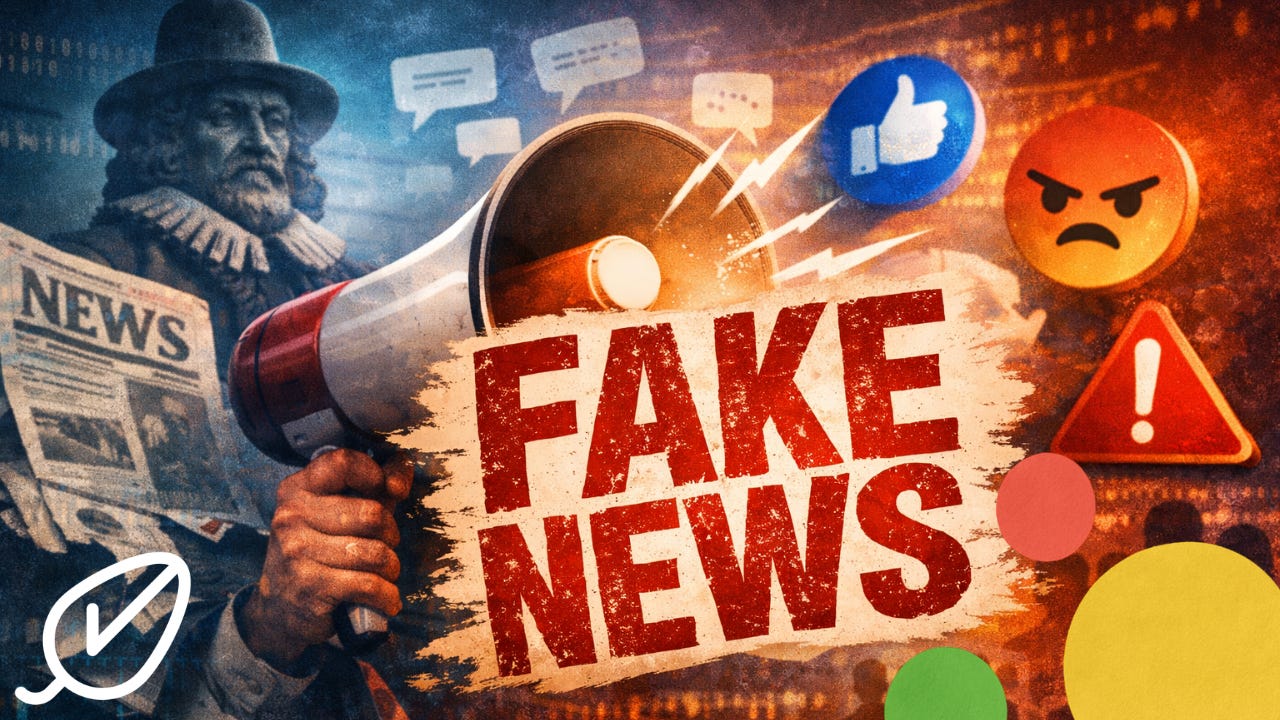
In the early seventeenth century, Sir Francis Bacon surveyed the landscape of human knowledge and found it cluttered with the wreckage of unearned certainty. In his seminal work, Novum Organum, he proposed a “Great Instauration”—a total reconstruction of science and thought.
Bacon’s most enduring contribution to this project was his diagnosis of the “Idols of the Mind,” the inherent cognitive biases that distort our perception of reality. Among these, none are more insidious or contemporary than the “Idols of the Marketplace” (Idola Fori). These are the misconceptions arising from the misuse of language and the friction of human social interaction.
Today, as we navigate a digital age defined by viral misinformation and linguistic drift, Bacon’s warnings feel less like historical philosophy and more like an emergency broadcast. We are losing our ability to agree on reality because the very currency of our thought—language—has been debased in the marketplace of modern discourse.
To understand the Idols of the Marketplace, one must first grasp Bacon’s critique of the human intellect. He famously argued that the human mind is not a “dry light,” but rather a “false mirror” that distorts the rays of truth by mixing its own nature with the nature of things. While the Idols of the Tribe represent our universal biological flaws and the Idols of the Cave represent our personal upbringing, the Idols of the Marketplace are uniquely social. They are formed, as Bacon noted, by the “intercourse and association of men.” In Bacon’s day, this occurred in physical markets and squares; in our day, it occurs in the infinite, instantaneous exchange of social media. The problem is that words are created by the “vulgar”—the common usage of the masses—for the sake of convenience rather than precision. When we try to use these blunt instruments to describe complex truths, the words “react back” upon the understanding, throwing everything into confusion and leaden disputes.
The crisis of modern reality is, at its core, a Baconian linguistic crisis. In the contemporary “Marketplace,” words have been severed from their empirical meanings. We use terms like “freedom,” “justice,” “violence,” “fake”, and “truth” as if they are fixed points on a map, yet their definitions shift depending on who is speaking and which digital tribe they belong to. Bacon warned that “words plainly force the understanding, and throw all into confusion, and lead men away into numberless empty controversies and idle fancies.”
Today, we see this in the “theft of terms,” where political and social factions hijack language to serve ideological ends. When the same word is used to describe two diametrically opposed realities, the word ceases to be a tool for communication and becomes a weapon of tribal signaling. We are no longer debating facts; we are trapped in a linguistic labyrinth where the walls are constantly moving.
This distortion is amplified by what Bacon called the “Methodological Innovations” of his time, or rather, the lack thereof. He criticized the scholars of the Middle Ages for their reliance on “Syllogisms”—logical arguments built on words rather than observations. He argued that if the words themselves are “faulty and confused,” the entire structure built upon them will collapse.
In our current era, we have built a massive technological infrastructure—algorithms, AI, and global networks—on top of these faulty linguistic foundations. When an algorithm prioritizes “engagement,” it is feeding the Idols of the Marketplace. It rewards the most sensational, least precise use of language because nuance doesn’t “sell” in the marketplace of attention. Consequently, our shared reality dissolves into a series of “Idols of the Theater”—false systems of belief and “stage plays” that we mistake for the real world because they are described in familiar, albeit hollow, terms.
Furthermore, Bacon’s Idols of the Cave—our personal biases—interact lethally with the Idols of the Marketplace. In the physical marketplaces of the 1600s, you might encounter someone with a different “Cave” (experience) and be forced to find a common language to trade goods. In the digital marketplace, however, we seek out those whose “Caves” look exactly like ours. We use language not to bridge gaps, but to reinforce the walls of our own personal delusions. This creates a feedback loop where the misuse of language (Marketplace) hardens our personal prejudices (Cave) and reinforces our inherited cultural biases (Tribe). The result is a total fragmentation of the “Common Sense.” If we cannot agree that a word represents a specific, observable thing in the physical world, we cannot engage in the inductive reasoning Bacon championed. We become like the “Sophists” he despised, spinning intricate webs of theory that have no contact with the ground.
Bacon’s “New Approach to Science” was a call to return to the things themselves—to “observe, weigh, and measure” rather than merely “discourse.” To reclaim a shared reality today, we must apply a similar rigor to our communication: observe, weigh, and measure. We must recognize that language is an imperfect technology, prone to “glitches” that Bacon identified four centuries ago. The “Marketplace” will always prioritize the easy word over the accurate one, the slogan over the study, and the “Idol” over the truth. Bacon suggested that the remedy lies in “Definitions,” but not just any definitions—definitions rooted in the “New Induction,” or the careful, systematic observation of facts. We must be willing to strip away the “Marketplace” labels and look at the raw data of our shared existence.
Ultimately, the Idols of the Marketplace remind us that human progress is not a straight line, but a constant struggle against our own cognitive limitations. Francis Bacon did not believe we could ever fully shatter these Idols—they are, after all, part of being human—but he believed we could “render them harmless” by being aware of them.
To agree on reality again, we do not need more information; we need better “Methodological Innovations” for how we process that information. We must treat our language with the same skepticism a scientist treats a contaminated sample. If we continue to let the “Idols” dictate our definitions, we will remain trapped in a world of “Theater,” watching false dramas unfold while the real world remains hidden behind a veil of poorly chosen words.
The “Great Instauration” of the 21st century must begin with a humble recognition that before we can fix our world, we must fix the mirror through which we view it.